
No one ever remembers when a defensive shift works. Just when it fails.
Take Sunday, for example. The Cardinals were hitless when they hit a ground ball when the defense was shifting when Joe Musgrove was on the mound, though the usually sure handed Erik Gonzalez did make an error. Chalk that up as a bad play by a defender rather than a bad shift.
But in the seventh inning, Matt Carpenter did this:
A hopper through where the third baseman vacated. Base hit. Yadier Molina follows with a homer, Pirates lose, 2-1.
Some would argue that the shift cost the Pirates the game. Personally, I would say the offense that mustered just two hits did, but I get the point.
A ground ball up the middle meant a base hit for 140 years. Now, it’s almost a 50-50 chance, depending on where the infielders are positioned. Four man outfields, five man infields, positioning that results in the Padres’ Manny Machado making a catch like this…
…while still being considered the third baseman. There is a treasure trove of batted ball data information. If a shift would significantly increase the probability of getting a batter out, why wouldn’t you do it?
“It's just common sense,” Derek Shelton said at the beginning of the season. “If you hit the ball in a certain place, we would want to stand there so we could catch it and throw you out. We're just trying to take our information the best we could and then best apply it to our group."
Shelton signaled during the first spring training that the Pirates were going to be aggressive with shifts, experimenting with four-man outfields and rearranging their infielders more than just about any team.
The Pirates have deployed a defensive shift 914 times this year, or for 46.3% of the batters they faced, per Baseball Savant. That is the third most in the majors, behind only the Dodgers (55.1%) and Tigers (50%).
It’s also a drastic increase over what they have done in years past. In 2018, they deployed 865 shifts. Despite playing only one-third of the games that team did, the 2020 Pirates have already shifted on more instances. And that notable increase has come over just two years:
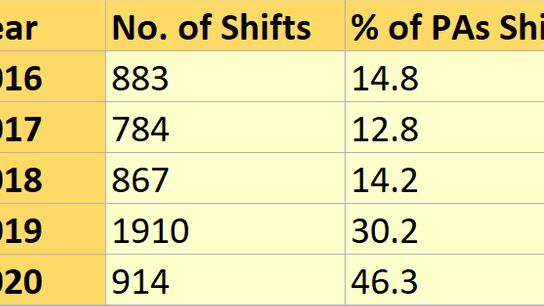
Courtesy of Baseball Savant.
That includes a massive increase in the number of times they have shifted a right-handed batter. Shifting against a lefty is a lot easier. The first baseman can stay in position and the third baseman or shortstop slides into the outfield grass and the left side of the infield is mostly left open. Against a right-hander, there need to be three infields on the left side, forcing the first baseman to play further off the line or leave a huge hole between himself and the second baseman.
Despite relying on Josh Bell and Colin Moran primarily at first, the Pirates have shifted right-handers 40.8% of the time. That would be the second-highest rate for a team since Baseball Savant started keeping track in 2016, and presumably baseball history, topped only by the Dodgers last year at 42.2%. They have a decent shot at setting the record, especially with the Cubs and the often-shifted Kris Bryant coming to town.
Ok, the Pirates are shifting a lot, but are they working? I asked Shelton about them, phrasing, perhaps unjustifiably, that the results have been mixed. He disagreed.
“I know in terms of gauging some of the defensive metrics we have and in terms of infield defense, we actually measure up extremely well,” Shelton said. “You’re gonna get beat by the shift or you're gonna get beat in terms of where people are standing at all times. But in terms of in terms of monitoring or evaluating, it's actually been pretty good.”
Upon a deeper dive, he’s right. They have been mostly effective.
I’ll be sticking with examining results with ground balls. You can argue that a batter could change his swing based on whether or not he sees a shift, and that change could result in a strikeout or a home run. Pitchers also try to attack certain parts of the zone to get a ground ball into the shift, and that could be hung too or bite even more. There are too many x-factors like that to take into consideration. We’ll just look at tangible results.
Here are the batting averages on ground balls in play compared to MLB averages, depending on who is hitting:
LHH: Pirates .184, MLB .209
RHH: Pirates .246, MLB .240
And compare it to batting averages for all shifts the Pirates have done from the past five years:
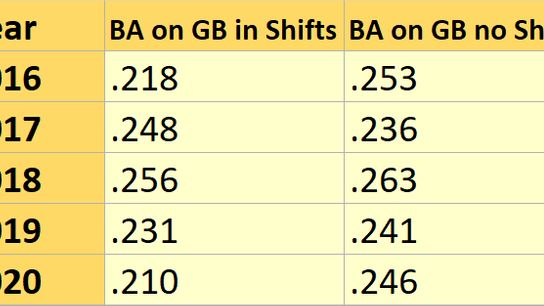
Overall, the shift results are pretty good. As a whole, it's the biggest gap in averages between a shift and standard defense. The ones against left-handers have actually been really good. Right-handers are more or less in line with the league average. Still, the experiment at the very least hasn't backfired.
As for errors, which have been a chronic problem for the team, they have seven errors on ground balls while shifting. They have eight in a standard defense. Considering they deploy both types of defense roughly the same amount of time, that is fairly consistent.
The shifts are still working, despite widening the net of who gets shifted. That’s a good sign. The infield has bought into the mindset from the beginning, actually shifting during intrasquad games during summer camp without any instruction from the coaching staff. Shelton was thrilled about that when it happened.
So what's next? They’ve drastically increased how often they shift the last two years. If they do anymore, they will be wandering into uncharted territory. Despite these shifts, the defense has still be graded negatively as a whole. Maybe that’s a way to close the gap a little further, or it might be too much of a good thing.