
COLUMBUS, Ohio — Alan Faneca was never so happy to be lost in his life — even in the dead of a Minnesota winter’s night.
The Steelers' former offensive lineman had arrived in Minneapolis on Feb. 2, 2018, as a Pro Football Hall of Fame finalist and someone eager to enjoy some Super Bowl LII revelry with his wife. The Fanecas eagerly accepted a dinner invitation from Franco Harris, Joe Greene and Oakland great Dave Casper, who was celebrating his birthday.
The group met for a four-block ride to the restaurant. What should have been a quick trip turned into an adventure.
“Everyone had their phones out, looking for the place,” Faneca recalled. “Everyone was laughing. It seemed like it took an hour, but then those guys started telling stories about the old days. It continued when we got to the restaurant.”
They were stories from a glorious epoch in NFL history, when pro football became a national obsession. The Steelers and Raiders met five consecutive years in the 1970s in playoff games filled with controversy and animus. The Steel Curtain. The Black Hole. The Immaculate Reception. Ken 'Snake' Stabler. Jack Lambert. Jack Tatum. Chuck Noll. John Madden before he became synonymous with a video game ...
And, of course, all the hard hitting and cheap shots the NFL would allow.
Faneca is a Super Bowl winner, a six-time All Pro. But as the tales and cocktails flowed, he felt like a fan soaking in history and mirth.
“They had all these great stories,” Faneca said. “There were so many guys who played on those teams for so long that they would have stories about jokes on the field, where they would be messing with each other during the games.”
As the evening unfurled, Faneca began thinking of another Steelers rivalry, one he helped forge, one the league might not see again in terms of continuity and competitiveness within the confines of divisional play.
This marks the 25th season of the Steelers versus Ravens series. It’s hard to imagine a more fitting way to celebrate a matchup that’s produced a combined four Super Bowls (two each) and 26 playoff appearances since 1996, but here we go: The Steelers (6-0) travel to Baltimore to face the Ravens (5-1) on Sunday in yet another showdown of two of the league's top teams. And the 50th regular-season meeting is set for Thanksgiving night at Heinz Field.
In 48 regular-season games, Pittsburgh holds a 25-23 advantage and the teams are separated by seven points, 964-957. Or, put another away, by the outstretched arm of Antonio Brown on the fourth-and-goal from the 4-yard line that delivered the Steelers a division title in the dying seconds of Christmas night 2016.
“Those stats are insane,” former Steelers offensive lineman Ramon Foster said. “That’s about as even as it gets.”
Some say the rivalry has lost a bit of its snarl and brio from the days when Terrell Suggs talked openly of “bounties” placed on the heads of Steelers players and Joey Porter stood outside the Ravens’ team bus after a game and challenged Ray Lewis to get off it.
It can be attributed to how the league nowadays tries to legislate mayhem that it turned a blind eye to for decades. Nevertheless, Ben Roethlisberger, who once had his nose broken by former Ravens defensive tackle Haloti Ngata, speaks affectionately of the annual AFC North dramas that test the mettle of its combatants.
“I didn’t get to play in it last year. I missed this.” Roethlisberger said. “As much as this game hurts physically at the end of the day, you miss this rivalry because this is fun. It’s football in its purest form.”
Faneca, who lives in Virginia Beach, left no doubt about his Sunday plans.
“As soon as I saw they were playing, I circled it right away,” he said.
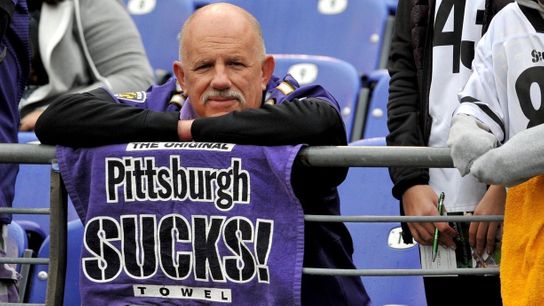
GETTY
A Ravens fan, Dec. 27, 2015, in Baltimore.
‘MEASURING STICK’
Over the past 40 years, the league has produced two dynasties — the 49ers of the 1980s and early 1990s, and the Patriots of the Bill Belichick-Tom Brady era.
Neither had a division rival of consequence. Many of the Niners’ most memorable games came against the Cowboys and in Super Bowls. As for the Patriots, well ...
“Who was New England’s division rival?” asked Pro Football Hall of Fame historian Jon Kendle. “Nobody. They just rolled over that division for so many years.”
This week’s Sunday night game features the Cowboys and Eagles. It’s been a strong NFC East tilt for decades. It now pits two teams with a combined four wins and nine losses.
The NFL’s oldest rivalry, Bears and Packers, is another game often hyped, if only for its history in the days before high-definition television. The Bears have just five playoff appearances since 1995 — the year Art Modell announced his intention to move his franchise from Cleveland to Baltimore.
“When the Ravens came into the league, we became their measuring stick,” Faneca said. “It didn’t take long for those games to become really intense.”
The Ravens didn’t make the playoffs until 2000, when they rode a suffocating defense to a Super Bowl title. In the nascent years of the rivalry, Baltimore's players were irked by the presence of so many Steelers fans populating their stands.
In 2001, defensive lineman Tony Siragusa, formerly of Pitt, suggested their fans should follow black-and-gold clad supporters “into the bathroom and take care of business yourself.”
“I told our fans to stop selling their tickets to Steelers fans,” Siragusa said years later. “So then, I might have said something crazy like they should pee on their leg.”
It didn’t take long for hostilities to reach the field.
The Steelers ended Baltimore’s championship reign in 2001 by eliminating them, 27-10, in the first of four postseason matchups. It also was the year Ravens tight end Shannon Sharpe mockingly referred to Plaxico Burress as “Plexiglass.”
Two years later, the irascible Porter, recovering from a gunshot wound to the buttocks he sustained a month earlier, went looking for Lewis after the game because the Baltimore linebacker had mimicked his leg-kick celebration.
By 2007, Ravens linebacker Bart Scott, one of the many trash-talking personalities in the rivalry, was threatening to kill Hines Ward for big hits administered to Scott and Ed Reed in the same game.
“I threatened him,” Scott told reporters the next day in Baltimore after the Steelers’ 38-7 win. “If I see him again, I’m going to threaten him again.”
Former NFL referee Gene Steratore, a Uniontown native, officiated his share of Steelers-Ravens games during the nastiest days of the rivalry.
Steretore, speaking on the WDVE Morning Show this week, said there’s usually an “unspoken fraternity” among players during the course of a regular season — a “we-don’t-cross-the-line-and-try-to-take-you-out” code. It’s also understood such sportsmanship fades as the playoffs approach.
“When you get to the postseason, players know, and so do officials, ‘Look, I’m taking you out today,’ ” Steretore said. “And that’s the intensity that goes up, nothing dirty, nothing unsporting about it but we’re dropping everything else and we’re taking you out. “This rivalry, to me ,was always that game in the regular season. It was a conference-championship-feeling type of a game where they just didn’t like each other. There’s no other rivalry, and I was lucky enough to work a ton of the rivalries, nothing compares in my mind to Pittsburgh and Baltimore. It’s that intensity, that ‘My job today is to take you out.’ It’s a great thing to be a part of.”
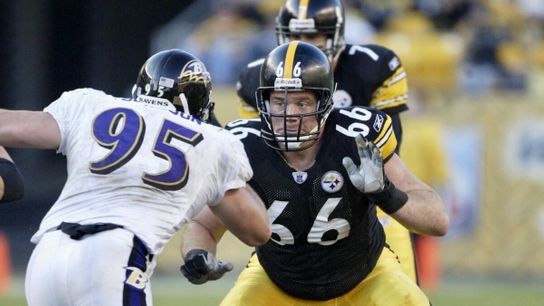
GETTY
Alan Faneca protects Ben Roethlisberger from the Ravens’ Jarret Johnson, Dec. 24, 2006, at Heinz Field.
‘A NEW NFL’
Minutes after Ryan Clark leveled Baltimore running back Willis McGhee with an unpenalized, helmet-to-helmet shot that induced a fumble and sealed Pittsburgh’s 23-14 AFC Championship Game win in 2009, CBS announcer Jim Nantz posed a question to broadcast partner Phil Simms:
Nantz: “Clean, legal hit, Phil?”
Simms: “Yes, it is. People say, ‘It’s helmet to helmet.’ Well, there’s no such thing as helmet-to-helmet when you have a ballcarrier down field and you’re a tackler.”
Listening to the YouTube clip, it’s a shocking, yet fairly accurate interpretation of the rules governing the game 11 years ago.
Nowadays, the field would be littered with penalty flags, and Clark potentially would be facing an ejection and major fine. Back then, McGhee spent a night in a Pittsburgh hospital with a concussion, while Clark won a Super Bowl ring two weeks later.
“It’s not as intense as it was in the height of the rivalry,” said Faneca, who played for the Steelers from 1998-2007. “There’s not as much extra-curricular activity after the whistle and stuff like that. It’s also a new NFL, and some of those hits aren’t allowed or kosher.”
Faneca said Bill Cowher was a master at finding bulletin board material, real or imagined, in the days leading up to a big game.
“Half the time, he would not tell you exactly what it was but it would piss you off that (the opponent) had said something,” Faneca recalled. “He would promise to tell you in three days, and a lot of times he wouldn’t tell you because it was probably completely fabricated. Cowher always looked for anything to add fuel to the fire. But in some respects, he had to temper us for those Ravens games.”
Faneca and Foster said young players, competing in their first Steelers-Ravens matchup, are quickly brought up to speed about the importance and temperature of the rivalry.
“Guys find out there are no plays off against the Ravens,” Faneca said. “You are exhausted at the end of that game.”
Such intensity has manifested itself in some of the era’s most hotly-contested games. Of the 48 regular-season meetings, 29 have been decided by seven points or less. In a remarkable stretch from Dec. 27, 2009 to Nov. 27 2013, nine of the 11 games were decided by three points or fewer.
Any wonder why the networks have slotted 11 of the last 26 regular-season contests for primetime?
“There’s a built-in culture in those two buildings,” said Foster, a DK Pittsburgh Sports columnist who played for the Steelers from 2009-19. “The Ravens have ‘Play Like A Raven.’ The Steelers have “The Standard Is The Standard.’ When Coach (Mike) Tomlin says that, he’s talking about the way this franchise has played since the days of Joe Greene. That’s what resonates, and when those two teams play each other, there’s a different kind of energy in those buildings and in those practices.”
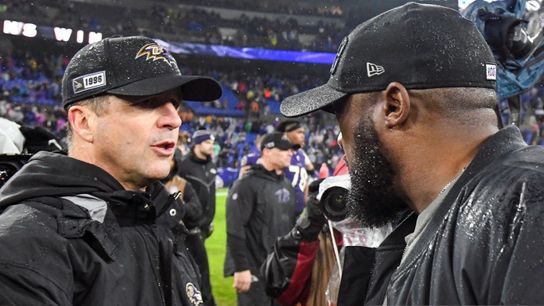
GETTY
John Harbaugh and Mike Tomlin after teams’ most recent meeting, Dec. 29, 2019, in Baltimore.
‘CAN'T CHEAT THE GAME’
Each season, the NFL updates its list of the most tenured coaches. Here were the top eight heading into 2020:
• Bill Belichick (Patriots) Jan. 27, 2000.
• Sean Payton (Saints) Jan. 18 2006.
• Mike Tomlin (Steelers) Jan. 27, 2007.
• John Harbaugh (Ravens) Jan. 19, 2008.
• Pete Carroll (Seahawks) Jan. 9, 2010.
• Andy Reid (Chiefs) Jan. 4, 2013.
• Bill O’Brien (Texans) Jan. 2, 2014.
• Mike Zimmer (Vikings) Jan. 15, 2014.
Eight coaches representing seven divisions. Only Tomlin and Harbaugh compete in the same one.
Such is life in a win-now league. If you can’t keep pace with the Belichicks and Paytons, owners are inclined to change regimes. That often translates into coaches and general managers cutting ties with holdover players. In the transient age of free agency, fewer and fewer clubs are keeping their cores intact.
From the front office down, the Steelers and Ravens have been among outliers.
“They are familiar with us, we are familiar with them,” Tomlin said. “There is continuity within schematics with both staffs and core players and things. I think that’s what adds to the intrigue.”
Given the league trend, it’s fair to wonder whether the Ravens and Steelers make up the last great divisional rivalry.
We’re not talking about five- or six-year stretches of terrific games between playoff-caliber opponents. Heck, even the Bengals under Marvin Lewis had a decent run in the AFC North from 2009-15.
Let’s use the Pittsburgh-Baltimore rivalry as a guide. Since the AFC North was formed in 2002, one of the two teams has won the division 14 times (Steelers eight, Ravens six). Dating to the Ravens’ inaugural 1996 season, Pittsburgh and Baltimore have missed the playoffs in the same year just three times: 1998, 1999, 2013.
Can you picture that sustained level of excellence within the same division anytime soon?
“The continuity with the two teams is what makes the rivalry so great,” Kendle said. “You don’t get that a lot today because there is this constant revolving door of players. Granted, the players are going to change with trades and free agency and salary-cap cuts. But the Steelers and Ravens have set the precedent for continuity in this era. Look at Cowher flowing into Tomlin. The Steelers didn’t skip a beat. They were still going after the same style of players as they were when Cowher was there. It’s been similar with Harbaugh replacing Brian Billick. Obviously, that has a lot to do with stability in management, too.”
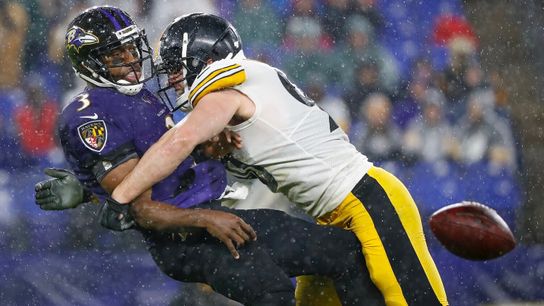
GETTY
T.J. Watt slams into the Ravens’ Robert Griffin III in the most recent meeting Dec. 29, 2019, in Baltimore.
The organizations mirror each other to the point where you could swap great defensive players such as Troy Polamalu and James Harrison for say Reed and Suggs and they would blend perfectly into each other’s bruising schemes and attitudes.
Knowledgeable fans understand the similar identities of the franchises. Kendle can’t recall how many times he’s watched an NFL Draft and said to himself, “that’s a perfect Steeler pick” or “that’s an ideal Raven pick.” He did it again this spring when Baltimore selected Ohio State running back J.K. Dobbins in the second round.
“(That rivalry) has to stand at the top of the list because of how close it’s been and all the great players who have played in the series and the meaningful games that have been played,” Kendle said. “Not just close games, but meaningful games with divisional championship implications. To me, that’s what elevates it.”
All Steelers fans have their favorite moments from the iconic series. There’s the Polamalu pick six in the 2009 AFC title game ... the AB “helmet catch” in the 2011 divisional-round playoff game ... the Tomlin pardon-me step off the sideline in 2013 to deny Jacoby Jones a touchdown return ... the furious fourth-quarter rally led by Roethlisberger to win the 2016 AFC North championship.
When Faneca distills the rivalry to its essence, he chooses a more obscure game — the 2003 regular-season finale. The Steelers were 5-10 and playing for pride. The Ravens were 9-6 and already assured the division title thanks to a Bengals loss earlier in the day.
But with Jamal Lewis chasing the single-season rushing mark, Billick elected to play all of his starters. The contest began with Porter and Lewis screaming at each other during the coin flip and ended with Matt Stover’s 47-yard field goal in overtime.
The Ravens lost several players to injury in what technically was a meaningless game before falling to the Titans the next week in the playoffs.
Billick was defiant in his decision to play his best lineup.
“It’s the Pittsburgh Steelers,” he told reporters after the game. “It’s a rivalry. You can’t cheat the game. You can’t cheat the fans.”
(Side note: The loss allowed the Steelers to move ahead of the Bills in the 2004 draft order. Former Buffalo coaches are on record as saying they would have taken Roethlisberger.)
Faneca laughs at the memory.
“They decided they had to beat us no matter what if they were going to go where they wanted to go that year,” he said. “It just goes to show you what that game means to the organizations and the cities. Teams rest guys in those situations. They do it now and they usually did it back then. But beating us meant just as much to them as a playoff game.”