
Evgeni Malkin was the Penguins' most valuable player in the regular season.
He led the team in scoring by an 18-point margin, finishing with 74 points in 55 games. His 25 goals finished two shy of Bryan Rust for the team lead, and he led in assists with 49. He stepped up in Crosby’s absence from a core muscle injury, leading the team with 11 goals and 27 assists in 26 games in that span.
His rate of offensive production at five-on-five was among the best of his career. His rate of 1.19 goals per 60 minutes played at five-on-five is the fourth-highest of his career. His rate of 2.23 assists per 60 minutes was the highest of his career, and his rate of 3.43 total points per 60 minutes was the second-highest of his career, just narrowly missing 2011-12’s rate of 3.47.
Then when the Penguins played the Canadiens in the qualifying-round series, Malkin all but disappeared from the series scoresheet, recording just one power play assist in four games during the Penguins' brief stay in the bubble.
Did Malkin's performance really fall off of a cliff in the playoffs? What happened?
Using Corey Sznajder's microstats visualizations from the series, we can see that Malkin was one of the biggest driving forces on the roster when it came to zone entries with possession. Looking at the data from five-on-five play, Malkin and Sidney Crosby led the Penguins with 19 offensive zone entries apiece:
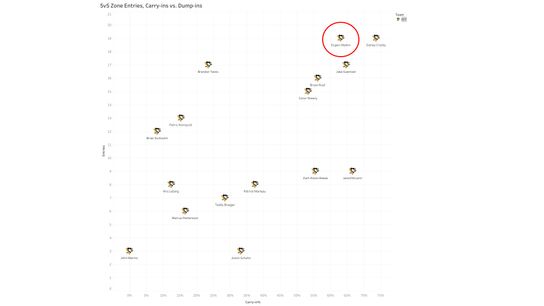
Of those 19 offensive zone entries, 12 were made when Malkin had possession of the puck, as opposed to dumping the puck in. With zone entries, success isn't necessarily a product of the number of zone entries, but rather the number of zone entries with possession, because zone entries with possession have been shown to generate twice as many shots, scoring chances, and goals as dumping the puck in.
Why didn't it necessarily translate into offense in this case?
After carrying the puck into the zone, when under pressure, Malkin would sometimes make decisions with the puck that would quickly lead to the puck changing possession, even if he didn't get credited with a giveaway, like this entry in Game 4:
A lot of the issues came from opting for fancy passes rather than the right passes, like this drop pass to Jack Johnson:
Several times throughout the series it just seemed like Malkin was trying to do too much. He'd recover the puck in the Penguins' zone and singlehandedly start the breakout, only to skate into a turnover:
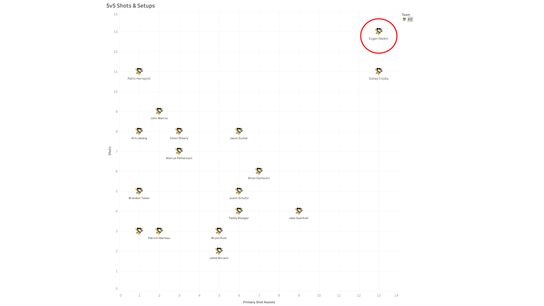
Still, Malkin both attempted and took more shots in the series than any other Penguins player. He led the team in total shots on goal (21, eight more than anyone else) and shot attempts (36, 10 more than anyone else). He and Crosby were tied for the number of five-on-five shots (13), and Malkin led the team in primary shot assists (13), setting up his teammates for more scoring opportunities than anyone else:
Those shots, of course, were always stopped by Carey Price, the Canadiens most valuable player of the series:
We do now know that Malkin was playing with a left elbow that wasn't at 100 percent during the playoffs, leading to offseason surgery, but a source told Dave Molinari that the issue that prompted the surgery existed prior to the series against Montreal.
The playoffs were a microcosm of the usual criticisms of Malkin's game. There's no question that he's capable of driving offense and creating opportunities, but his decision-making when the puck is on his stick has to be better. The room for error is so much smaller in the playoffs, especially when running into such a hot goaltender.