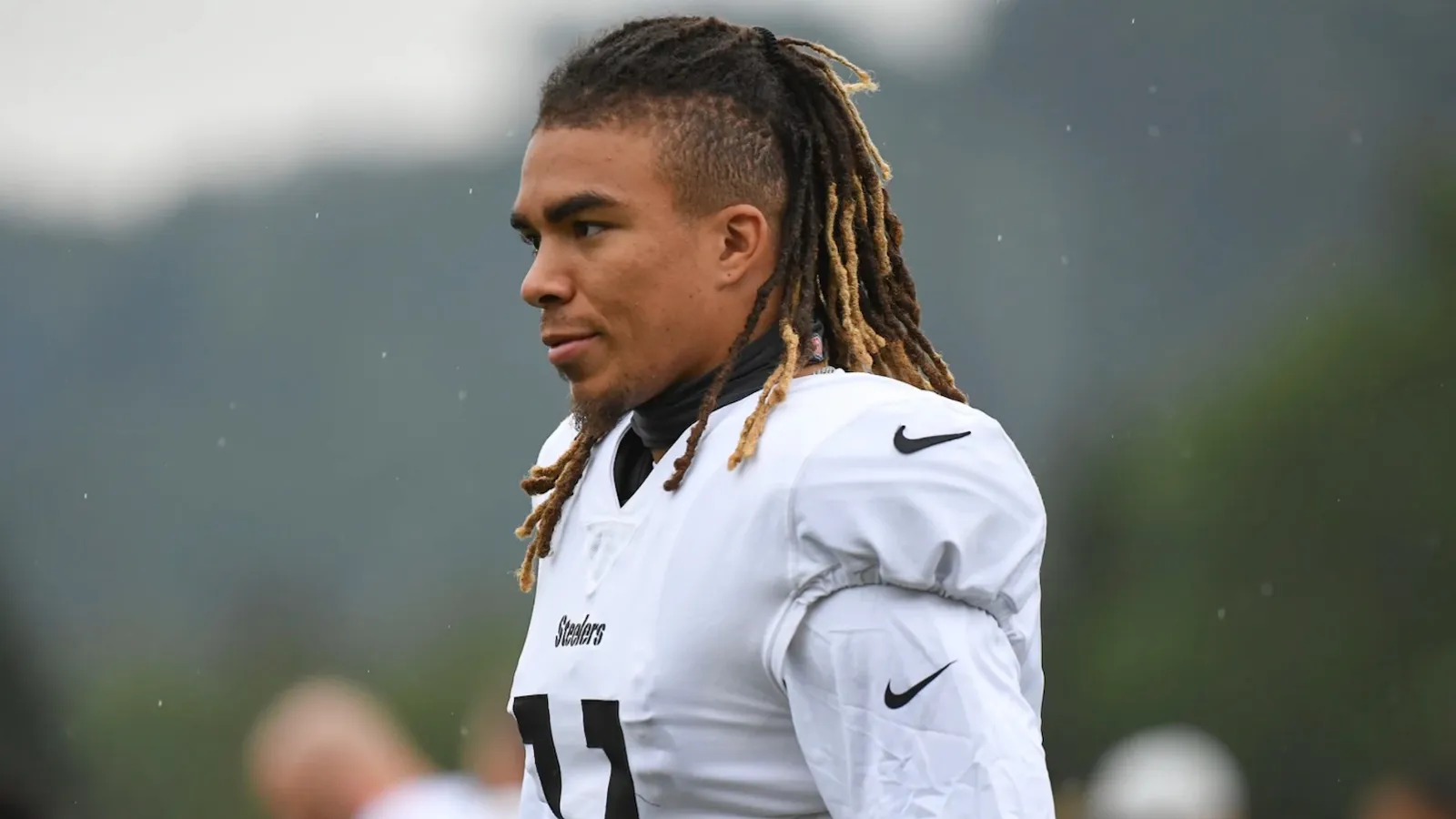
This was supposed to be a season in which the Steelers didn't get much out of their rookie class because of the lack of any kind of in-person offseason program and no preseason games.
But the Steelers have gotten considerable contributions across the board from their rookie class as part of their 9-0 start, as all have played roles at some point or another, with the final piece to the puzzle being sixth-round pick Antoine Brooks significant playing time in last week's 36-10 win over the Bengals as a dime safety.
"Those guys are working extremely hard, and I would be remiss if I didn’t mention the quality leadership that we have from our veterans players who do a really good job of embracing our young people and not only helping them in terms of schematics and X’s and O’s but way of life things, how to take care of your body and things of that nature," said Mike Tomlin. "We have a really good culture here in that regard, and I would imagine if you ask the rookies that they would echo the same sentiment that the veteran support that they get is significant in terms of allowing them to answer the challenges of playing."
The Steelers took a different tactic in this year's draft than they had at any other time in the Tomlin era. Whereas in previous years, the team would take chances on high-upside, younger players in the draft, this year the average age of their picks was 22.7 years old, with fourth-round running back Anthony McFarland being the only player under 22.
But in a year in which COVID-19 restrictions limited the amount of exposure the coaching staff had to the players and canceled the preseason, having players who had played more football at the college level seems to have worked out.
Second-round pick Chase Claypool has scored nine touchdowns and needs two more in the final seven games to match the team rookie record. Third-round linebacker Alex Highsmith has played a considerable amount as a backup to T.J. Watt and Bud Dupree and looks like he'll step into the lineup in 2021 when Dupree leaves in free agency. Guard Kevin Dotson, the second of two fourth-round picks, has made two spot starts and performed well enough that the team could consider allowing left guard Matt Feiler to leave in free agency after this season.
But does the success of this group mean the Steelers will eschew taking young, upside players in the future to take more finished products?
Not necessarily. One of the reasons why the Steelers have taken chances on those high-upside young players is because of where they've been picking in the draft. Typically, they're in the bottom half of the first round -- and usually in the 20s or lower. You're not getting the true blue-chip players at that point. They're picked in the top dozen or so selections.
With those players off the board, the Steelers take some chances on raw and athletic young players they hope will develop into stars. It worked with Dupree, Stephon Tuitt, JuJu Smith-Schuster and others. It didn't with Artie Burns.
The other part of drafting younger players is that when it comes time for their second contract, you're giving it to them at 24 or 25 as opposed to 26 or 27.
But given what's happened with this draft class and its immediate impact, perhaps the team will look at that differently moving forward.
MORE STEELERS
• The Steelers defense is doing a lot of good things this season, not the least of which is forcing three-and-outs by opposing offenses. The Steelers have forced 27 three-and-outs this season, second only to the Bears, who have forced 28. The Bears, however, have played one more game than the Steelers and are off this week. The problem is that the Steelers have had 25 three-and-outs themselves. If this team figures out part of its game, look out. The Steelers are scoring 30.1 points per game -- tied for fourth-best in the league -- despite those failures. Just one fewer wasted possession per game would go a long way, especially since the Steelers are eighth in the league in terms of scoring on a touchdown on 31.6 percent of their possessions. -- Lolley
• One of the interesting things regarding the return of Mike Hilton this week will be how the team utilizes Cam Sutton. Sutton has played 167 snaps in the past four games with Hilton out and has produced 15 tackles, two pass defenses, and a forced fumble in each of the past three games. He now leads the team in forced fumbles. Sutton had largely played in the dime defense opposite Hilton prior to the latter's injury, never playing more than 21 snaps. But the Steelers would like to get Hilton on the field, as well. Maybe they can figure out a way to get them both on the field more often. "I take repos everywhere," Sutton said this week. "Week in and week out, I am never stationary. It might depend on the day or the week or the situation throughout the week. Normally, throughout the week, I am not stationary at one position. ... That is just my style of game, being versatile is being able to come from outside to inside, being able to play safety and come down to being able to play dime, nickel. Whatever it takes to be on the field and around the ball. That's just what it is." The Steelers have so many useful defensive backs, when they wanted to get Brooks on the field because they wanted another big defensive back in the dime to help stop the run, it came at the expense of second-year corner Justin Layne, who had been playing in the dime. And former starting safety Sean Davis also is waiting in the wings. Who would have thought we'd see a day when the Steelers would have so many defensive backs they couldn't get them all onto the field? -- Lolley
PENGUINS
• Penguins executive Tom McMillan plans to retire in June after spending a quarter-century in the team's front office. McMillan, now listed as "senior advisor, Communications" on the organizational depth chart, has served in a variety of roles, including a long run as vice president of communications. His involvement with the team began long before he became an employee, however. He's a North Hills native who followed the franchise from its earliest years and covered it for a number of media outlets, with stints as the beat writer for the Post-Gazette, editor of an independent newsletter and talk-show host on WTAE-AM when it had an all-sports format. McMillan, whose knowledge of the Penguins has few rivals, is expected to remain a part-time advisor for the team after retiring. -- Dave Molinari
• Add Jim Rutherford's voice to the chorus of those perplexed by the decision of Ontario minister of sport Lisa MacLeod to allow the Ontario Hockey League to conduct games this season only if bodychecking is prohibited. Rutherford said while he obviously would defer to the judgment of health professionals, taking contact out of the game will not eliminate close-quarters battles for the puck that would appear to be more likely sources of coronavirus spread. "If some of the scientists and experts suggest (bodychecking) is a cause of (spreading) COVID, I guess they're doing the right thing,' he said. "It seems to me that they have to get rid of the scrums, where they're right in each other's face. I'd like to get rid of half of those scrums, anyway. This would be a good time to do it." -- Molinari
• Word out of Boston this week was that the Beanpot, a fixture on that city's sporting calendar and probably the most celebrated tournament in college hockey, will not be held in 2021 because of the pandemic. While it's unlikely that the news surprised anyone, it likely inspired a few grimaces and groans among Penguins personnel, who represent all four of the schools that participate in the event every February. They include Mike Sullivan and Evan Rodrigues (Boston University), Brian Dumoulin (Boston College), Zach Aston-Reese (Northeastern) and John Marino (Harvard). The good news for Aston-Reese is the Huskies, once a perennial weakling in the field, will have their run of three consecutive Beanpot titles remain intact for at least another year. -- Molinari
PIRATES
• With Keone Kela and Nick Burdi now free agents, the Pirates do not have a clear back end of the bullpen in place for next season. One internal option who will return next year is Edgar Santana, who made his debut in the Dominican Winter League this week, striking out a batter and allowing two hits over ⅔ of an inning. After missing the end of 2018 and all of 2019 because he underwent Tommy John surgery, Santana was busted for taking Boldenone, a performance-enchancing drug, and missed the entire 2020 season. His fastball velocity and slider command were both back to normal during the first spring training in Bradenton, Fla., so it is safe to assume he will have an opportunity to earn a late inning role in 2021. -- Alex Stumpf
• When the Pirates drafted right-hander Logan Hofmann in the fifth-round of the 2020 draft, he was predominantly a fastball and curveball pitcher, though he did occasionally mix in a slider. He spent some of his 2020 after being drafted at his college at Northwestern State, where he started working more on a slider. "I think I found a grip I like," he told me. "Sometimes I drop my arm slot a little bit, so I'm trying to make sure I release it where all my other pitches are being released." Hofmann already has a high spin curveball, sitting in the 2,600-2,700 rpm range. If he adds in another breaking pitch, it would be another weapon to mask his fastball, which sits in the low-90s. -- Stumpf
• It’s no secret the Pirates’ outfield was dreadful offensively in 2020, finishing with a combined .190 batting average and .578 OPS, both the worst in the National League since at least 1901. It did improve defensively though, going from being worth -40 defensive runs saved in 2019 to +5 in 2020, per the Fielding Bible. That 2020 figure was weighed down a little by Cole Tucker, who had -6 DRS as he was learning the position on the fly. Part of the improvement was due to cutting some bad defenders, such as Melky Cabrera, but a lot can be credited to the work of first base and outfield coach Tarrik Brock. One of the players who improved the most was Gregory Polanco, who went from -5 DRS to +1 in almost the same amount of playing time. Yes, some of that was due to his shoulder being healthier, but the Pirates also tweaked his angle in the field, positioning him a little closer to the line while not changing his depth. Going by Baseball Savant’s data, he ended up running more direct routes this year and did much better going back on the ball. -- Stumpf