
The Penguins' third line next season looks to be Jared McCann, Mark Jankowski, and Evan Rodrigues.
"That gives us speed on the wings," Jim Rutherford said after signing Jankowski and Rodrigues on the opening day of free agency. "It gives us the defensive center we're looking for. I don't want to compare Jankowski to (Nick) Bonino ... but it's more along those lines of what we had when we were having more success in '16 and '17."
The Penguins have been seeking a true third-line center since Bonino left in 2017, and it has been a costly process. The following February, they traded Ian Cole, Filip Gustavsson, Ryan Reaves, a 2018 first-round pick and a 2019 third-round pick in a three-team deal to acquire Derick Brassard, who just never fit in the third-line center role.
A year later, the Penguins sent Brassard, Riley Sheahan, a second-round pick and two fourth-round picks to the Panthers in exchange for McCann and Nick Bjugstad, and both players spent time in the third-line center role. Bjugstad wasn't ever quite able to stay healthy and didn't contribute much when he was, and he was shipped off to Minnesota this offseason.
All the Penguins have left from the search is McCann, who struggled in the role last season and just seems to be better-suited for the wing.
After costly failed attempts, the Penguins turned to Jankowski on a league-minimum, one-year deal this offseason.
Jankowski is more of a defensive forward, and to say that his offensive production varied between the last two seasons would be an understatement. He went from 14 goals and 18 assists in 79 games in 2018-19 to five goals and two assists in 56 games last season. That's a massive drop.
"He's a big center who's good defensively," Rutherford said. "When I say 'good defensively,' the two years prior to (2019-20), he scored enough goals that we would be comfortable with him as a third-line center, because of his defense. If he can score in that range, 14 to 17 goals, like he did the two years prior, we'd be pretty pleased with that.
"He's coming off of five goals. That's not a good year for a player like this. But being a first-round pick (in 2012), I'm sure that if you asked him and the Flames, they would say they had higher expectations. ... What we're looking for is, really, for him to get back to that, where he was two years ago and three years ago."
What happened to Jankowski last season, and what factors could have contributed to the decline in offense? Let's take a look:
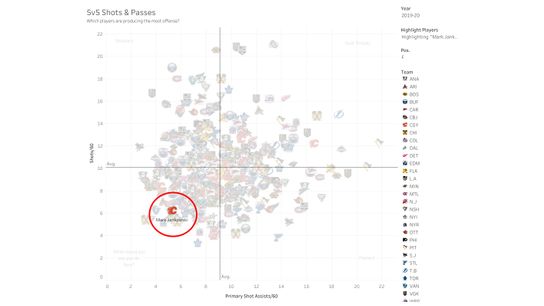
It wasn't that pucks weren't going in for Jankowski last season. He wasn't really contributing much in shot production at all. Corey Sznajder has a tool that aims to visualize which players are contributing the most offense by looking at their rate of shots and primary shot assists per 60 minutes of five-on-five play. Jankowski was among the players in the league who contributed the least offensively, averaging 6.2 shots on goal per 60 minutes and 5.32 primary shot assists per 60 minutes. This visualization shows Jankowski in the bottom left quadrant that includes players who are neither shooters nor passers:
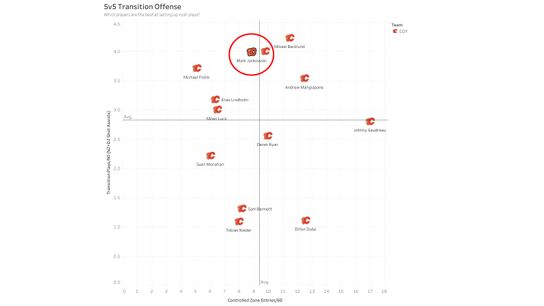
One area where Jankowski could help offensively, though, is in the transition game. Using another of Sznajder's tools that looks for the sources of offense created off of the rush, Jankowski actually stands out in one regard. His rate of carries into the offensive zone was 8.87 per 60 minutes, which is about average. But he was among the Flames' best forwards last season in this metric called "transition plays," which is a combination of neutral-zone and defensive-zone shot assists -- essentially breakout passes that lead to a shot off the rush. In that area Jankowski averaged 3.99 per 60 minutes of ice time. For context, the only Penguins forward who averaged more last season was Jake Guentzel, who averaged 4.435.
One of Jankowski's two assists last season came off of one of those plays. He blocked a shot in his own zone then passed the puck from the neutral zone, earning a secondary assist:
There's still the hope that Jankowski could bounce back offensively. Using Bill Comeau's SKATR tool, we can see just how much Jankowski fell off offensively compared to the 2018-19 season.
He went from 12.53 shot attempts per 60 minutes to 8.54. His on-ice Corsi For percentage went from 51.47 percent to 48.84 percent.
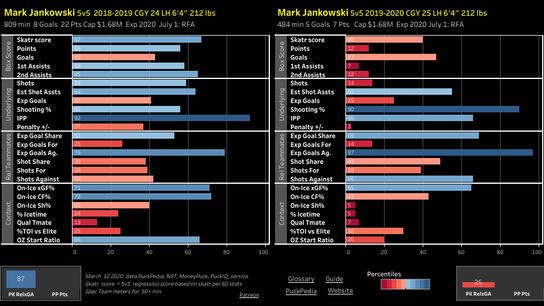
But when we look at the context behind those numbers, we see that there are a couple of things that changed for Jankowski from 2018-19 to 2019-20 that could help explain the diminished offense.
In 2018-19, Jankowski had 58.33 percent of his faceoff shift starts begin in the offensive zone, which was in the 66th percentile among forwards that season. In 2019-20, that dropped to 46.15 percent, in the 20th percentile. He was deployed in a more defensive role that didn't set him up for much offensive success. This could also explain why his number of transition plays that led to rush offense was so high, because he spent more time in his own zone, giving him opportunities to make those plays. That increased defensive zone time also likely contributed toward his increased rate of takeaways, going from 2.74 per 60 minutes to 3.1.
The quality of opponents faced by Jankowski increased, while the quality of teammates on the ice with Jankowski decreased. He went from his most common linemates being James Neal and Sam Bennett to Tobias Rieder and Michael Frolik. McCann alone produced more than Rieder and Frolik combined last season.
At worst, Jankowski is a cap-friendly third-line center who is reliable defensively. But if he can get his offensive contributions back to where they were two seasons ago, he could prove to be a steal.