
At first glance, Chad Kuhl’s 2020 season looked fairly pedestrian. A 4.27 ERA, 1.36 WHIP and 8.6 strikeouts per nine innings were all very close to in line to what he produced before his 2018 Tommy John surgery. That’s not particularly exciting, but for a team looking for starting pitching depth, it’s a good backend of the rotation stat line.
A deeper dive didn’t paint as pretty a picture, though. He had a 5.48 FIP. His average exit velocity allowed was 89.5 mph, which raked in the bottom 28% league-wide. Almost all of his expected stats ranked in the bottom 11% of the league. His walk rate skyrocketed from 9.2% in his first three years to 14.2% in 2020.
But that doesn’t tell the whole story either, for Chad Kuhl is a pitcher of extremes, some good, some bad.
Before we do an even deeper dive, some context. Kuhl had Tommy John surgery in September, 2018 and made his return in 2020. The Pirates were being extremely mindful with his workload during the first spring training, and any plans they had were drastically readjusted during the shutdown. They were now in a position where they didn’t want him to pitch too many innings to protect his arm, but they needed to guarantee him innings in order to build back some strength and get him into game situations again.
The compromise was to use him in a piggyback role with Steven Brault, giving him a consistent two or three innings an outing. Injuries to the rotation forced Derek Shelton to split the two up after a couple outings, but the Pirates kept a close eye on his workload and put him on a lower pitch count for some starts throughout the season.
Kuhl also dealt with another intrusive, but far less career threatening ailment with a recurring cuticle/blister on his index finger. That forced him to exit one outing early and made it very difficult for him to throw his sinker in a September start against the Royals. He allowed nine runs in that start in Kansas City over 2 1/3 innings.
It’s worth mentioning Kuhl allowed only 13 more earned runs over his other 44 innings pitched outside of that Royals start. That’s a 2.66 ERA. Of course it’s not exactly fair to omit a bad start, especially when the sample size is already pretty small, but it’s a good indicator that for the most part, Kuhl had a pretty good year with some ugly peripherals.
We’ll get to the ugly in a moment, but let’s start with the good. Kuhl threw more breaking balls this year, throwing his slider 34.5% of the time and his curve 17.6%. One of my first Mound Visits theorized that Kuhl would be better off throwing these two pitches more, and this year proved that he could throw his breaking stuff more than half the time and get batters out.
Batters went 15-for-95 (.158 batting average) with just two home runs against 39 strikeouts against his slider and curve. Baseball Savant tracks how many runs each pitch is worth over the course of a season. Kuhl’s slider had a run value of -6, the best of any pitch on the Pirates, cumulatively. Going by pitch value per 100 times thrown, the best pitch on the Pirates’ staff was his curve, finishing with a run value of -4.
Just how rare is it to have two breaking pitches that play well? The only other pitcher to have both a slider and curveball valued at -4 runs or better in 2020 was Tejay Antone of the Reds.
“We love both of his breaking balls, the curveball and the slider,” pitching coach Oscar Marin said towards the end of the season. “The high spin that they get, the swing-and-miss, chase that they get, absolutely. Playing off of those and working the fastball off of those pitches has probably been the best thing for him.”
But what about the worst pitches on the Pirates' staff? Well, the absolute worst was Dovydas Neverauskas’ fastball, at +10 runs. It’s a shocker, I know.
Second worst? Kuhl’s sinker, at +7. Batters hit .300 against it, slugged .667 and took it deep six times. The batted ball profile suggested results even more pessimistic than that.
Kuhl came into the year less concerned about his velocity, believing chasing those extra couple miles per hour messed with his execution. As a result, his heater went from sitting around 95-96 mph to 93-94 mph. He also ditched the four-seamer and reverted back to just throwing sinkers.
Maybe that approach was wrong. Perhaps the blisters were the main culprit. Kuhl did find a remedy for his final two starts after Kansas City by soaking his finger in lime juice, and his results were much better.
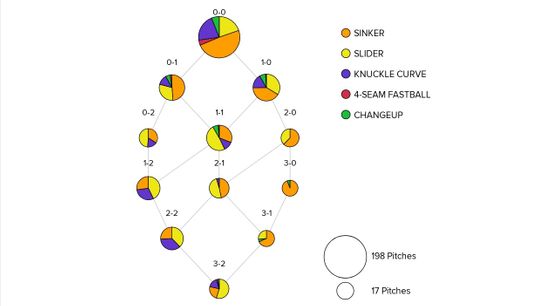
Kuhl’s extremes may be explained by how he attacks hitters. Marin mentioned how Kuhl had his fastball work off the breaking pitches. That was really only true when he got ahead in the count:
Courtesy of Baseball Savant.
The breaking pitches, especially the curve, were kill pitches for when Kuhl got to two strikes. He would use them early in the count too, but if he fell behind, or if the at-bat went longer, he went back to the sinker, which was usually hit hard.
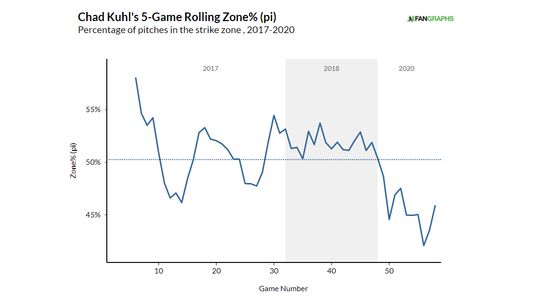
Kuhl needs, more than most, to get ahead in the count early so he can be able to use all of his pitches throughout the at-bat. If a hitter is sitting fastball, it’s probably going to be hit. That’s what makes Kuhl’s walk rate so concerning. He wasn’t just issuing free passes, he was having a harder time finding the strike zone:
Courtesy of FanGraphs.
This doesn’t seem to be a product of the increase in breaking balls, though. Going by Baseball Savant’s data, 42.2% of his sinkers were in what GameDay considered the strike zone. The league average is 51.7% for sinkers. He’s not locating the fastball. When it's in the zone, it gets tagged. You see the problem.
Kuhl will have to cut down on the walks and stay in the zone more in 2021. That’s a given, but the solution isn’t so simple. Kuhl’s sinker has always been hit hard, and he can’t let hitters just wait for one. He went back to throwing sinkers mostly for comfort. Maybe mixing in more four-seamers will help it play better. He could also try throwing more breaking stuff, including when he gets behind. Guys won’t sit fastball if they don’t know if they’ll get one.
The results don’t really show it, but Kuhl took a big step in 2020. He and the club took cues from former Pirates pitchers like Gerrit Cole and Charlie Morton and had him pitch to his strengths more. Now they have to expand on that.