
Doug Dieken, like many NFL players of his era, toiled away at off-season jobs to supplement his income. If teaching school and working at the Department of Commerce had not been such nice side hustles, the former Browns offensive tackle could have made an excellent addition to the Greater Pittsburgh Convention and Visitors Bureau.
“We stayed in most of the hotels in Pittsburgh over the years,” Dieken said. “I don’t know whose idea it was, whether it was (owner) Art Modell or (coach) Sam Rutigliano, but they were trying to find ways to change our luck. ‘Let’s try another hotel. That might do it.’”
Dieken played for Cleveland from 1971-84. He never won a game in Pittsburgh — a dubious distinction shared by many Browns’ players down through the decades.
The tales of superstition and silliness are legion.
In 1980, the club used a second-round draft pick on a defensive end named Cleveland Pittsburgh Crosby. He wasn’t with the franchise long, but Crosby left a lasting impression.
“We were getting ready to play a game in Pittsburgh and the night before the game here comes Cleveland Pittsburgh Crosby to a team meeting wearing a Steelers T-shirt,” Dieken recalled. “Sam took one look at him and told him to take it off. He sat there through the whole meeting with no shirt on. I don’t know if he was trying to be funny and loosen up the team, but I can tell you nobody was laughing.”
When it comes to road games in Pittsburgh, any Browns’ player would give the shirt off his back for a victory.
The Browns are not only battling the Steelers on Sunday night in an opening-round playoff game at Heinz Field, but their own tortured history in Pittsburgh which, since 1970, has been a living ‘L.'
Cleveland holds the longest current road losing streak in the NFL against a single opponent, which stands at 17 games dating to 2003. The all-time mark is 24 straight losses for the Lions against the Packers, a skid that ended in 2015.
The Browns dreadful run in Pittsburgh ranks third — right ahead of a 16-game drought also belonging to the Browns against . . . you guessed it, the Steelers from 1970-85.
“The biggest thing for us is just focusing on what we have to do,” said Browns’ defensive tackle Larry Ogunjobi on Monday, a day after Cleveland earned its first playoff appearance since 2002 with a 24-22 win over the Steelers at FirstEnergy Stadium. “A lot of times, you can get caught up in everything else that’s going on. We have respect for them. It’s been kind of a one-sided battle for a long time. But this is a different team.”
There’s no question this iteration of the Browns (11-5) is the best in more than a decade even with COVID-19 issues that will force them to leave coach Kevin Stefanski and Pro Bowl left guard Joel Bitonio at home.
It’s a young team with designs on competing for AFC North superiority in the near future. But until the Browns clear the mental hurdle of winning in Pittsburgh, where they are 6-44 in the past 50 years, it’s hard to imagine them achieving their loftiest goals.
“(The Steelers) are a physical team, and they find different ways to win and compete, no matter what,” quarterback Baker Mayfield said. “All we wanted was a chance, and now we have it.”
It’s not like the Browns haven’t had opportunities to deliver memorable wins in the Steel City.
° They have lost a pair of playoff games to the Steelers, including the 2003 classic in which they squandered a 12-point lead in the final four minutes to fall 36-33.
° They have lost 12 games in Pittsburgh by four points or less, including a 2017 contest in which Corey Coleman dropped a potential game-winning touchdown pass on their final offensive play to seal an 0-16 season.
° They lost a game in 2015 in which the Steelers planned to rest Ben Roethlisberger only to see the Browns injure quarterback Landry Jones and have Roethlisberger come off the bench to throw for 379 yards and three touchdowns. It remains the NFL record for yardage by a quarterback who did not start a game.
For their fans, too many Browns’ trips to Pittsburgh have ended in blowout losses, concussions and late-season firings.
“I have seen multiple Browns’ coaches and GMs get escorted out of Heinz Field and not get on the bus with the team,” said Cleveland sportscaster Andre Knott, a former Browns’ sideline reporter. “I saw them put (former general manager) Phil Savage in an unmarked cop car and take him home to Cleveland.”
There have been some bad breaks and bad calls contributing to the Browns’ misery index. But mostly it’s been the Steelers’ dominant lineups that have sustained them in the turnpike rivalry.
See if you can spot a trend in the following quote.
“When I played, they had Hall of Famer Lynn Swann, Hall of Famer John Stallworth, Hall of Famer Mike Webster, Hall of Famer Franco Harris, Hall of Famer Terry Bradshaw,” Dieken said. “On the other side of the ball, there was Hall of Famer Joe Greene, Hall of Famer Jack Ham, Hall of Famer Jack Lambert, Hall of Famer Mel Blount, Hall of Famer Donnie Shell.
“Did I miss anybody?”
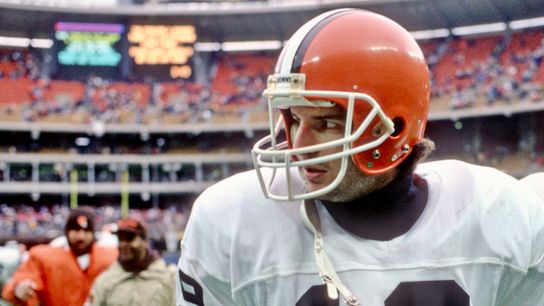
AP
The Browns’ Bernie Kosar at Three Rivers Stadium in 1987.
STREAK BUSTERS
In the late 1980s, former Penguins’ winger Bob Errey was at a Pittsburgh bar one night when he enjoyed a chance meeting with a Browns quarterback. It was Bernie Kosar.
The two pro athletes struck up a conversation. Errey likes football. Kosar is a hockey fan.
“Bernie is a really good guy,” said the Penguins’ television analyst and two-time Stanley Cup champion. “I kind of kept track of his career for awhile.”
Errey and Kosar have something in common beyond reaching the tops of their respective professions. They each know what it’s like to be members of teams that ended legendary road losing streaks.
In 1986, Kosar led the Browns to a 27-24 win to snap the Three Rivers Stadium Jinx.
Three years later, Errey and the Penguins traveled to Philadelphia and beat the Flyers, 5-3, to stop a 42-game slide (39 losses, three ties) dating to 1974.
“Honestly, there were a lot of players that went into Philadelphia and played in fear — physical fear because the Flyers were a tough team and a tough team to play against,” Errey said. “There were times when I think we lost before we even got there.”
Errey’s teammate Phil Bourque remembers a night at the old Spectrum when the Flyers scored nine goals and the home crowd was chanting, “We want 10, we want 10.”
“I lined up for a defensive-zone faceoff and there were just seconds to go and Bobby Clarke was about to take the draw and I swear he was frothing at the mouth because he wanted to get that 10th goal,” Bourque said. “You went into that building thinking, ‘I hope I survive and I hope we can keep it close.’ ”
The Browns can relate.
Kosar grew up in Youngstown, Ohio, the epicenter of the Browns-Steelers rivalry due to the high concentration of fans supporting those teams.
“You lived and died with those games between 1 and 4 p.m. on Sundays,” said Kosar, a lifelong Browns’ follower. “But the Steelers usually found a way to win those games, especially in Pittsburgh.”
The Penguins and Browns finally bloodied the noses of their tormentors for the same reason: Their rosters grew strong enough to compete.
The Browns of the mid-1980s were built on the running game and the heady play of Kosar. They had two quality backs, Kevin Mack and Earnest Byner, and they won much in the same way the current Browns are winning with Nick Chubb and Kareem Hunt.
After suffering a one-point loss in 1985, Kosar said the Browns were confident of breaking through at Three Rivers Stadium the following year.
“When we went to Pittsburgh in 1986, we were coming in the front door and we weren’t afraid to lose,” Kosar said. “There was no talk of superstition. We’re coming to town to kick their ass. You’ve got to play to win on the road. You’ve got to take it away from them, not hope they will lose it.”
Kosar said the 27-24 win over the Steelers helped change the club’s trajectory. The Browns won four consecutive times in Pittsburgh, including a 51-0 opening-day thrashing in 1989, and they made three trips to the AFC Championship Game during that span. The shutout loss remains the largest in Steelers' history.
The Penguins’ historic win in Philadelphia also helped them on the road to future glory paved by the brilliance of Mario Lemieux.
“Was it important in the evolution of what we finally achieved? I think it was,” Errey said. “A big part of hockey or any sport is belief. Unless you do it, how are you ever going to believe it can get done? It certainly lifted a weight off our shoulders.”
Added Bourque: “It was huge. It brought us together as a team and it continued the snowball of hope that started with Mario. It was like, ‘OK, maybe we have something here.’ ... It helped us believe we could win in any environment."
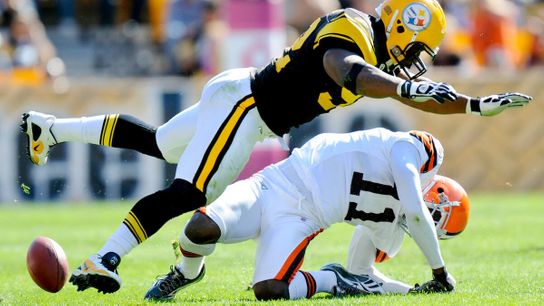
AP
James Harrison knocks out the Browns' Mohamed Massaquoi in 2010 at Heinz Field.
TAKING THEIR LICKS
Knott was standing along the Browns’ sideline at Heinz Field on Oct. 17, 2010 — “the day that changed football,” as the Cleveland sportscaster terms it.
James Harrison knocked out two Cleveland players, Mohamed Massaquoi and Josh Cribbs, within a seven-minute span in a 28-10 win. The Massaquoi hit made the cover of Sports Illustrated as part of a special report on concussions in the NFL.
The helmet-to-helmet shot that felled Cribbs was newsworthy for a different reason. Harrison and Cribbs are friends and former Kent State teammates. Their post-game meeting made for an unforgettable encounter.
“We’re down in the locker room area and the Steelers are coming through,” Knott said. “Mike Tomlin stops and puts his arms around Cribbs and tells him what a tough guy he is. Then, here comes James and his mom. They are walking together. James give Cribbs a hug. Harrison’s mom comes up and gives Josh a hug, too, and then she turns and smacks James in the arm and says, ‘Why did you hit that boy like that?’ James sheepishly shrugs his shoulders and says, ‘Mom, I’m just doing my job.’ ”
In some ways, the Browns-Steelers rivalry relocated to Baltimore in 1996 when Modell moved his franchise there. The Steelers-Ravens matchup has evolved into the league’s best over the past 20 years with both sides winning a pair of Super Bowls during that stretch.
Meanwhile, the Browns struggled for purchase as endless regime changes delivered new rosters that didn’t have an appreciation for what Steelers’ games meant to their fan base. Cleveland’s only win at Heinz Field came in 2003, an out-of-nowhere 33-13 victory on a Sunday night. Its only other triumph in Pittsburgh since returning to the league was a 16-15 victory in the first season back in 1999.
“The Browns history is broken,” Knott said. “I hate to say it, but I know the real rivalry is Steelers-Ravens. The Browns haven’t been able to emotionally touch what the Steelers and Ravens have because of that factor. The Browns want (the rivalry), but they don’t get it.”
Knott has seen the Browns’ sideline grow “eerily quiet” when the Heinz Field game-ops department plays the video montage for “Renegade.” The Steelers’ de facto anthem supplied one classic exchange between Browns’ teammates who were watching it on the scoreboard.
“Half those damn ‘Renegade’ videos are of Browns players getting hit upside the head,” said Knott, who now works as the Indians’ in-game reporter. “I’ll never forget there was a Browns’ linebacker — and I won’t say his name — but he was looking at the ‘Renegade' video and he said, ‘Why don’t we have shit like this at home?’ And another player looked at him and said, ‘because we don’t hit anybody like that.’”
The Browns arrived at Heinz Field in October percolating with confidence following a 4-1 start. There was talk of finally ending the long losing streak, especially with only a small crowd on hand to cheer the Steelers.
If ever there was a chance to win in Pittsburgh, it seemed like 2020 provided the perfect opportunity. The lack of large crowds or, in some cases, no crowds due to COVID-19 restrictions, helped road teams go 127-128-1 league-wide. Instead, the outcome was decided in about 10 minutes.
The Steelers scored on their first drive and Minkah Fitzpatrick followed with a pick six en route to 38-7 romp.
“Mayfield throws like the worst pass ever,” Knott said. “I wasn’t there, but when he throws that interception, you could tell those players were defeated.
“They get another shot now and I’m hoping for the best, but the demons are real over there.”
HUMOR ME
If FirstEnergy Stadium is the "Factory of Sadness," what does that make Heinz Field in the eyes of Browns fans?
That’s the question posed to stand-up comic and lifelong Browns’ supporter Mike Polk Jr., who hung the famous moniker on his home stadium.
“I know you want a joke here,” Polk said. “I’m not stalling because I don’t have one, but what’s happened in Pittsburgh can’t compare to the misery (at FirstEnergy Stadium). That’s our home. Terrible things can happen to you when you’re out of town, but you’re supposed to have nice things happen when you're home. Heinz Field hasn’t been any less kind to us than every other stadium in the NFL. Based on our experiences since 1999, there’s no road stadium that we look forward to going to and say, ‘We own this house.’ The scene of the crime, though relevant to the crime itself, is irrelevant to we the victims all these years.”
Polk is not wrong.
The Browns have been a brutal road show regardless of the venue. And yet, they have managed to win three times in Baltimore since 2003. They also have won games at Lambeau Field and the Superdome.
The comic dislikes the Steelers and the Ohio-born Roethlisberger, who’s an outrageous 24-2-1 against the team that passed on him in the first round of the 2004 draft. But Polk reserves his most venomous barbs for a subset of Steelers’ supporters.
“I have nothing against Steelers’ fans from Pittsburgh and Western Pennsylvania — life has dealt them a rough enough hand and I’m not going to pile on,” he said. “But I’ve always had a great deal of trouble with Steelers’ fans living in Cleveland. They are on another level of unacceptable. Always with some loose, pathetic justification for their allegiance like they were conceived at a concert their parents attended in Pittsburgh. Or, that their great uncle was a mascot there in the '70s. If they just said, ‘I wanted to follow a consistently dominant team,’ I wouldn’t like it but I would respect the honesty.”
Polk is thrilled with the progress of his Browns, who have produced their best record since Bill Belichick coached them in 1994. He believes the pressure is squarely on the Steelers (12-4), who are trying to wring one more Super Bowl out of an aging and salary-cap strapped roster.
“We are playing with house money as far as I’m concerned,” he said. “We made the playoffs, that’s a huge step. We won 11 games. If we win Sunday, it’s fantastic. It’s the ultimate humiliation for the Steelers. But if we lose, nobody is going to come away saying, ‘the Browns stink.’ Everyone is going to have a chip on their shoulders for next year.
At some point, “next year” must become this year if the Browns hope to evolve into a contender. That likely will necessitate a win at Heinz Field. In their two playoff runs since 1990, the Browns have been swept in the season series by the Steelers and lost both playoff games in Pittsburgh.
“You have to be aggressive against them, you can’t play not to lose,” Kosar said.
Dieken has been part of the Browns’ organization for 50 years — first as a player and now as a radio analyst. He’s seen far too many losses to the Steelers than he cares to recall.
On Dec. 24, 2006, Dieken and Knott were walking out of FirstEnergy Stadium after a 41-0 tanning at the hands of Pittsburgh. The headline in the next day’s Akron Beacon Journal read: “Season’s Beatings.”
“It’s cold and miserable and we’re almost to our cars, and I turn to Dieken and say, ‘Merry Christmas, Diek,’” Knott said. “He looks at me as only he can and says ‘the (freaking) Steelers ruin everything. The turkey won’t be as good, the gifts won’t be as good.’ That is the rivalry. The Steelers ruined Christmas for Diek.”