
It won’t be a drastic overhaul, but next year’s Pirates rotation is going to look different. Trevor Williams and Chris Archer are gone. Jameson Taillon is back. Joe Musgrove is on the trade block. There will be some holdovers, like Mitch Keller and Chad Kuhl, and some pitching prospects should make their debuts midseason, like Cody Bolton and Max Kranick. But after a couple years of mostly the same rotation, things will start to look different in 2021.
Then there is Steven Brault. At the beginning of the offseason there was a report that said he could be a trade target. There hasn’t been anything on that front since. Trades could still materialize before spring training, but all signs point to Musgrove being the most likely member of the rotation to be dealt.
Brault has worn many hats the last two years. Starter, reliever, piggyback guy. He’s done his best as a starter, pitching to a 4.23 ERA and 4.39 FIP over 138 ⅓ innings. Yes, that omits a couple terrible performances, like when he walked three and allowed three hits without recording an out on Aug. 7, but when he is officially listed as a starter, he’s put up about league average results.
Streaky, but mostly average. He wore a couple bad outings last year, but he ended his season with back-to-back terrific starts: A complete game two-hitter in his penultimate start and seven shutout frames in his finale.
To borrow Brault’s words, he became “a freaking throwing machine” those games. He didn’t read scouting reports on hitters for those two games. Whatever Jacob Stallings called for, he threw, no questions asked.
Brault believes he does his best work when he doesn’t overthink things. He made some mechanical changes this season to try to take better care of his shoulder, and when things went wrong -- like that Aug. 7 outing -- he said he was thinking too much about his motion. Turning off his brain seems to work, and hey, ignoring scouting reports and just trusting his catcher is so anti-analytics that it shoots the moon and becomes pro-analytics.
Maybe the only takeaway from those last couple starts is that “freaking throwing machine” Brault is probably the best version of himself, but there was a tangible difference in those last couple starts. He threw his changeup a lot more.
Brault has a five pitch mix: Four-seamer, sinker, slider, curveball and changeup. The curve is a show-me pitch that he’ll throw once or twice a game. The slider -- which is sometimes classified as a cutter -- is his traditional secondary offering.
But the fastball is Brault’s calling card. Take his start on Sept. 1, 2019 against the Rockies. It was one of his best outings of the year, and he threw a four-seamer or sinker for 77 of his 82 pitches. It’s not a blow-it-by-you pitch, but he can move it around the zone and when things are going well, he can challenge hitters with it.
He cut back on his heaters in 2020 though, throwing it a little over half the time, compared to 64% in 2019. Instead, he upped his changeup usage, especially in his final three starts of the year:
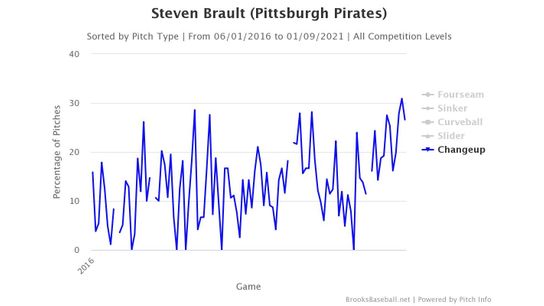
Courtesy of Brooks Data Baseball.
That’s Brault’s changeup usage for every start in his career. He’s had individual games where he relied on it a lot, but he never strung together multiple outings where he kept going back to it. Those were oddities, just one-offs to try to get through the season.
So why does this matter for his last two starts? Because batters went 0-for-16 against it in those games.
It was a short season, but looking back on it, Brault’s results with the changeup were among the best in baseball last year. Among the 113 pitchers who had at least 25 plate appearances end with the pitch, Brault’s had the sixth-lowest slugging percentage allowed (.182), the fourth lowest wOBA (.169) and the fifth lowest xWOBA (.192).
He gets a decent amount of whiffs and strikeouts with it, but it’s really his ground ball pitch. Since the start of the 2017 season, batters have an average launch angle of 0 degrees against his changeups. He’s one of just 11 pitchers to hold hitters to that low of a launch angle during that time, alongside pitchers like Stephen Strasburg and Zack Greinke:
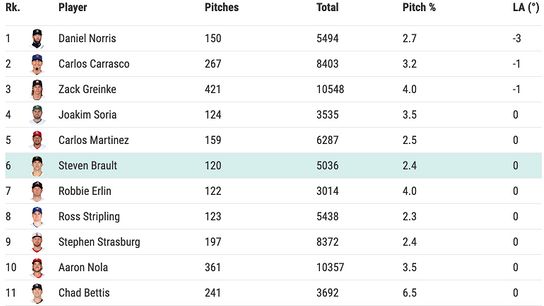
Courtesy of Baseball Savant.
It’s basically a slowed down two-seamer, not just because it has good vertical movement, but because it spins similarly. Both are going to drop towards his arm side, trying to hit that low, outside corner to right-handed hitters.
Baseball Savant recently added really useful charts illustrating spin direction for pitchers. Here’s how each pitch spins, from the batter’s point of view:
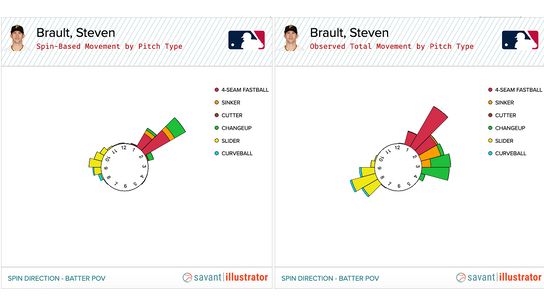
Courtesy of Baseball Savant.
Rather than break it down by degrees, Baseball Savant measures increments in time, like a clock. (Think 12-to-6 curveball.)
Mike Petriello and Tom Tango have both written about spin direction over the past week, and I would recommend both pieces. But to put that chart about Brault into layman’s terms...
“The changeup has the same spin as the two-seam, so it comes out looking like a two-seam fastball,” Stallings said on Sept. 17, the night of Brault’s complete game. “You see two-seam spin and it starts to slow down, and then it's a changeup, and it's got a lot of depth to it.”
This is why Brault’s changeup works. He doesn’t have to rely on sequencing or use it only as a waste or kill pitch. He can, and will, throw it early in the count and in situations where he needs a strike. The changeup and sinker spin and move almost identically, so if you’re a batter, your only hope is to try to identify the difference in velocity to try to separate the two.
And when he has it working, like he did when he turned his brain off, he can keep batters off balance all game. Stallings recognized that and used it throughout, especially in the final inning of the complete game.
Tommy Edman bounced a changeup to third for the first out:
Then Paul DeJong went down swinging on a 3-2 count:
And then one more punch out on a changeup to end it, this time at Paul Goldschmidt’s expense:
Same pitch. Basically the same spot. Same result.
In a macro sense, Brault tends to do better when he throws his changeup more. Of course, that can change game by game, because he can’t use it as often if there are a lot of left-handers in the lineup. His greatest obstacle in the Majors has been his control, but when he’s able to change velocity while mimicking spin and movement, he can keep batters off balance and get away with mistakes in the zone.
And when he has that control and his changeup working, he can turn into a freaking throwing machine.