
COLUMBUS, Ohio — Brandon Tanev played his freshman season at Providence College at 160 pounds, a weight that would have looked right at home on the university’s cross-country roster, but not on its men’s ice hockey team.
Anticipating as much, the Friars’ coaching staff generously listed him at 170 pounds for his first two seasons and 180 pounds for his final two seasons. His height was never disclosed on the school’s online roster.
But if there were player-safety concerns during Tanev’s time in Providence they were reserved for unsuspecting opponents, ones who never dreamed somebody so small and light could arrive at the point of impact with such ferocity.
“He’s fast and he’s fearless and he will put some DNA on you,” Friars coach Nathan Leaman said.
A decade later, little has changed. Tanev remains undersized by NHL standards and he plays the game the way so many others did before a greater emphasis was placed on slick skating and puck possession.
In a league where hitting and physicality are on the wane, the Penguins’ speedy winger delights in stirring up shifts. He skates in straight lines. He finishes checks. He blocks shots like he’s padded in those sumo-wresting costumes occasionally worn by participants in between-periods contests.
“I talked to him the other day after he got hit in the ribs by an (Alex Ovechkin) slap shot,” said former Jets teammate Adam Lowry. “(Tanev) just put an ice pack on it and laughed it off. That’s how he’s wired. He’s a slight guy, but he goes up against anyone. He goes into the corners, he steps in front of shots and gets knocked down, but always gets up with a pep in his step.”
As a kid, coaches told Tanev he was too small to play high-level hockey. Now, he’s the kind of third-line winger a lot of general managers are looking to add to their playoff-contending teams. Not necessarily ones coming in 6-foot, 180-pound packages, but ones who play the gritty style that’s always in demand every spring.
A year after an embarrassing first-round sweep, the talent-laden Lightning acquired wingers Blake Coleman and Barclay Goodrow, who along with Yanni Gourde, formed the NHL’s best third line en route to a 2020 Stanley Cup title.
Tanev played a similar role in Winnipeg with Lowry and Andrew Copp in helping the Jets reach the 2018 Western Conference Final. The Penguins hope the line of Tanev, Teddy Blueger and Zach Aston-Reese — temporarily broken up due to an injury to Jason Zucker — can provide the same dividends if the club qualifies for the playoffs.
“We want to play in all scenarios, be on the ice in the last minute of the game getting the job done,” said the 29-year-old Tanev in a phone interview. “It’s the confidence we’ve built with each other. We all play similar styles. We want to play fast and play physical and we relish playing against the other teams’ top lines. That’s something you take pride in.”
When Tanev was a 4-foot-11, 100-pound ninth grader he would have never thought any of it possible. Fortunately, he had an older brother and a former Penguins’ Stanley Cup champion to help navigate an unlikely path to the NHL.
WORKING MAN
Blue Jackets’ coach John Tortorella calls it a “no-hit league.” Rangers’ coach David Quinn says the success of the Islanders’ Matt Martin-Casey Cizikas-Cal Clutterbuck line is attributed to the fact “those players are few and far between in this day and age.”
There are ample theories as to why bumps have replaced body checks in the NHL. The most popular and, likely the most accurate, involves the infusion of speed and high-end skill. It’s hard to hit what you can’t catch. Connor McDavid rarely become a chalk outline because he’s so difficult to line up. And if you miss him, you take yourself out of defensive position. It’s why so many of today’s players are taught the importance of stick checks to quickly win back possession.
Others skaters not named Tom Wilson also worry about risking suspension in a league that’s trying to crack down on late and concussive hits. And then there’s the premise that familiarity now breeds content. Elite players have gotten to know each other over the years through numerous tournaments and social media. It’s not uncommon for rivals to play video games against each other during the season.
The on-ice fraternization reached a point where former Penguins' coach Dan Bylsma wouldn't stand on the bench during pre-game warmups because he hated the sight of his players chatting with opponents across the red line.
This was never an issue for Tanev growing up in the hockey mecca of Toronto. The Tanev brothers, Chris and Brandon, were so small they were routinely cut in tryouts. Both spent several years playing roller hockey and competing in summer ice-hockey tournaments just to stay in the sport while they waited and prayed for growth spurts.
The younger Tanev didn’t develop friendships with players his age who were thriving in major junior hockey. He was too busy stocking shelves in a grocery store and assisting customers at a golfing-supplies shop. Tanev also ran cross country, played soccer and competed on his high school hockey team, which is many rungs below the Ontario Hockey League.
Did his NHL dream ever die during those years from ages 15-to-18?
“It dimmed — that would be the right way to put it,” Tanev said. “It’s never easy to step away from something you are so passionate about, especially being a kid from Toronto. It was tough at times, but looking back on it, it made me a tougher person going through the adversity. I was fortunate to go through those other life experiences before coming back into (high-level) hockey. It helps you instill some values in your life that you carry with you.”
Encouraged by his parents, Tanev kept finding ice time when he could. It was never about a lack of desire or hustle. He goes through life like a 7-year-old on his fifth bowl of Count Chocula. Teammates are amazed by his energy levels.
We’re talking about a hockey player who doesn’t take pre-game naps. That’s like a baseball player who doesn’t spit.
“He’s a guy who wasn’t handed anything,” said Blue Jackets’ forward Jack Roslovic, who played with Tanev in Winnipeg. “He would joke and laugh about it, but he was working in a store while a lot of us were playing hockey. When he got back into it, he knew the effort it would require, and I don’t think he’s taken a day off since then. He just never stops.”
Tanev drew inspiration from his brother, Chris, who’s two years older and grew a foot prior to his senior year in high school. The defenseman earned a hockey scholarship at Rochester Institute of Technology and signed as an undrafted free agent with the Canucks’ organization in 2010. Chris Tanev (6-2, 198) just entered his 11th NHL season.
Brandon Tanev was still only 5-foot-7, 150 pounds as a 19-year-old, but won a roster spot with the Markham Waxers of the Ontario Junior Hockey League. While playing in a summer tournament in suburban Boston, he caught the attention of Leaman, who left Union College in 2011 for Providence.
“Brandon was so skinny, but he was tenacious and his motor was unreal — it never shut off,” Leaman said. “We used to joke that we needed to get toys in the penalty box so if he took a penalty he would have something to do in there.”
Tanev met future Penguins’ teammate Mark Jankowski at Providence and the duo won an NCAA title together in 2015 with Tanev scoring the winning goal in the Frozen Four.
By the time he left college in 2016 with a degree in marketing, Tanev had transformed his body thanks in part to natural maturity and an old Penguins’ hero. The Tanev boys had begun training in the offseason with Gary Roberts at his facility in Ontario.
Tanev is a workout fiend and under Roberts’ direction they honed a frame capable of withstanding the pounding of a long, unforgiving season.
“Brandon just busted his butt in the summers,” Leaman recalled. “With the way he plays, guys can wear down. But you almost never saw it with him. He’s just so relentless.”
GETTY
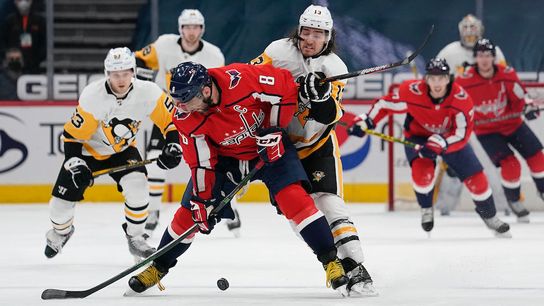
Brandon Tanev hounds the Capitals’ Alexander Ovechkin Thursday night in Washington.
HITS KEEP COMING
Tanev received about a half dozen free-agent offers after completing his four years at Providence. The interest was much higher in 2019 as he hit the open market again following three solid seasons with the Jets in which he scored a combined 22 goals over the final two campaigns.
The Penguins had not been a suitor when Tanev turned pro, but no team was more keen on signing him two summers ago. Both Jim Rutherford and Mike Sullivan were part of the presentation and they moved quickly, offering Tanev a six-year, $21 million deal.
The contract, particularly the term, drew some criticism within the fan base and around the league. But after being swept by the Islanders in the first round, the Penguins knew they needed more jam in their game to complement the talents of Sidney Crosby, Evgeni Malkin and Jake Guentzel.
What they saw in Tanev was a player who could drive their bottom six forwards with effort, penalty killing and intangibles.
“That’s my identity, that’s my role,” he said. “It’s what’s allowed me to establish a consistent role in the NHL. You have to have an understanding of what you need to bring to the table to help your team win. You’re not running around to make hits, but at the same time when you get in on the forecheck and play physical, it can change the momentum of the game.”
Over the past four-plus seasons, Tanev ranks eight in the NHL with 920 hits. Some consider it a dubious stat and believe elevated totals reflect a player who never has the puck. But anyone who watches Tanev buzzing around rinks with that mudflap of brown hair hanging from his helmet recognizes the value.
His speed enables him to get to checks, especially in an era when so many defensemen are mobile and adept at avoiding them. It’s not about blowing up players the way Wilson did Thursday night with a late hit on Jankowski that drew a minor penalty. It’s about creating turnovers and limiting space.
“Maybe, it changes the way the opponent plays,” Tanev said. “Maybe, the next time the guy goes back for the puck, he won’t be as confident with it.”
Tanev, Blueger and Aston-Reese have developed good chemistry over two seasons, and Sullivan is feeding the trio more responsibility. Pirmanti Brothers hasn’t named a sandwich in their honor as it did for the Carl Hagelin-Nick Bonino-Phil Kessel line during the 2016 Cup run, but it’s hard not to see the potential.
Most championship teams boast productive third lines. Tyler Kennedy, Jordan Staal and Matt Cooke supplied that spark in 2009 for the Penguins. Lars Eller played a pivotal role in the Capitals’ 2018 title with seven goals and 11 assists in 24 playoff games.
Conversely, the less said about the Patrick Marleau experiment in Pittsburgh the better.
“Generally, the top two lines on most teams are so talented that on any given night, it’s going to be a (wash) depending on how special teams goes,” Lowry said. “When you have a third line going, it takes a little mileage off your top guys from having to play 24 minutes a night. Those minutes add up.”
GETTY
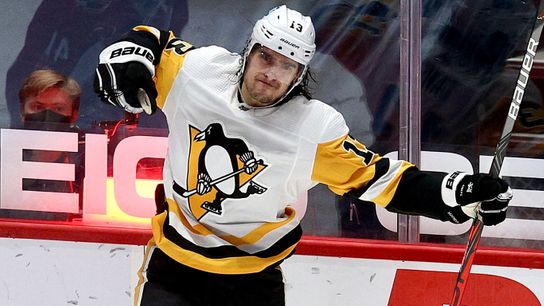
Brandon Tanev celebrates a third-period goal Thursday night in Washington.
REFLECTED GLORY
Late in the second period of Thursday’s game, Tanev was felled by a Brendan Dillon point shot. It was one of those agonizing blocks that could be felt in living rooms across Western Pennsylvania.
As the puck skittered out of the zone, most figured Tanev would skate gingerly to the bench. Instead, he stayed on the ice, waited for the play to come back to him and stapled Conor Sheary into the wall like an insect pinned to a science-fair corkboard.
“There’s not a lot of glamour playing that type of game, but at the end of the day it’s whatever the team needs from you,” Tanev said of his approach. “That’s what matters most.”
Since the start of the 2016-17 season, Tanev ranks 10th among forwards with 255 blocked shots. (Bonino is first with 350.) Tanev registered four blocks in the 5-2 loss to the Capitals to go along with a team-high five hits.
He also scored his eighth career shorthanded goal in the third period after nearly tallying another in the second period. It’s a reminder Tanev can contribute in ways that don’t involve applying ice packs to body parts after the game.
His five goals this season are fourth on the team behind Guentzel, Crosby and Bryan Rust.
“He plays the same way every night,” Lowry said. “He hasn’t changed his game a bit despite signing a long-term deal.”
Lowry hasn’t played with Tanev in two years, but he speaks to his former teammate three or four times a week. He couldn’t resist taking a jab at Tanev’s wide-eyed headshot that went viral from almost the moment it was posted on the Penguins’ website.
“He says he saw a ghost,” Lowry said. “I say he saw his reflection.”
The image of Brandon Tanev has changed little since he landed at Providence College a decade ago. The hair is longer and the scrawny frame has filled out, but beneath it all he remains the same tenacious player who knew there was more to life than stocking grocery-store shelves in Toronto.