
Mike Sullivan's been blessed to send superstars over the boards from the day he arrived here.
That's blessed, as in not cursed.
Because there've been stretches in that span when Sidney Crosby and/or Evgeni Malkin were out -- or even a handful of the Penguins' headline players, as will happen again in tonight's sequel meeting with the Islanders, 7:08 p.m., at PPG Paints Arena -- and the team would still somehow ... not just succeed, but systematically rise above.
That was the case early in the 2019-20 season, when a sluggish start was soon followed by Malkin, Bryan Rust and two other forwards going down ... which was soon followed by a wonderful back-to-back swing through St. Paul and Winnipeg, in which the Penguins out-worked and, really, out-everythinged the Wild, 7-4, and the Jets, 7-2.
If not, here's an excerpt from what I wrote late on that mid-October night from Bell MTS Place:
____________________
Building a foundation from the back out, creating offense from defense, fronting the puck at all points on the rink, prioritizing possession above all … it works. Sullivan’s system, when applied with passion and precision and the right people, works. But there’d better be the right people at hand.
When I asked after this game if there’s any correlation between the injuries and the Penguins finding themselves to this degree, Sullivan candidly replied, “Uh, probably.”
Oh, my. Could have answered that a zillion different ways. He chose that one.
“I think it’s pretty sound evidence that it’s an effective way to win in this league, regardless of who’s in your lineup," he continued. "We talk a lot about being hard to play against. I think this is the definition of it.”
He paused, as if to accentuate that.
“It starts with your puck possession, the decisions that you make, the line changes you make that put your teammates in good positions, the back pressure on the puck so that we have numbers back. It’s a lot of the little details that we talk about and show on film and practice every single day. But …”
Another pause, before repeating with more oomph, "For me, this is the definition of being hard to play against. We’re starting to really form an identity that I think is a whole lot of fun. When everybody contributes the way this team has over the last week, it’s a real rewarding experience for everybody involved.”
____________________
Wow. Copy and paste, right?
Flash-forward to today, more than a full, miserable year since I've been to magnificent Manitoba, and the script remains familiar. Painfully so.
Malkin's missing again, as is a third of the rest of the lineup: Kasperi Kapanen, Teddy Blueger, Brandon Tanev, Mark Friedman and, although he's now close to returning, Jason Zucker. (Mark Jankowski's also out, but that's addition through subtraction.) Before that, five of the team's six opening-game defensemen, meaning everyone except Cody Ceci, were hurt for multiple-game stretches. And that's to say nothing of the infrequent but recurring absences for COVID-19 protocol.
In all, the Penguins have lost 188 man-games to injury and/or illness, third-most in the NHL behind the Blues and Blackhawks. If going strictly by injury, they're second to the Blues.
For further reference, that 188 figure would extrapolate to 437 over a normal 82-game regular season that'd mark the second-most over the past three decades.
And yet ...
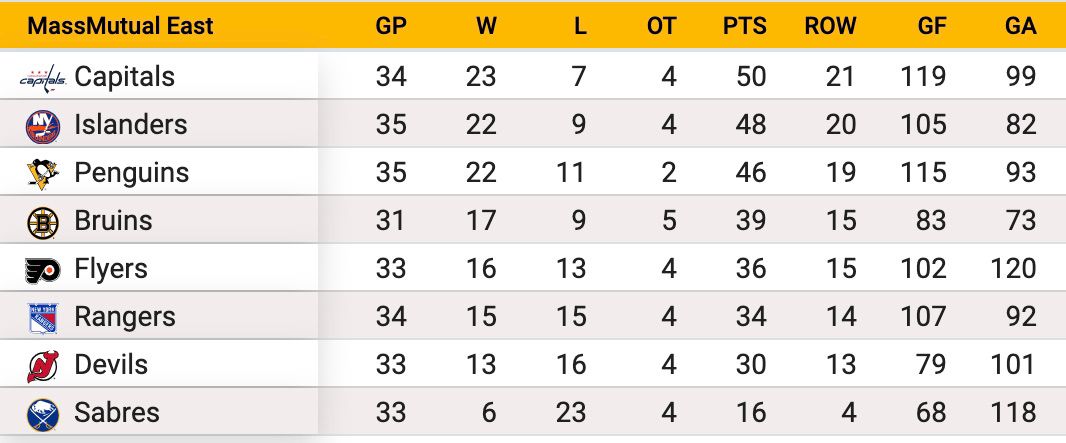
This season saw two opening losses in Philadelphia, a 5-5-1 start through 11, a seemingly endless slog that was salvaged only by overtimes and shootouts, some of the NHL's ugliest goaltending through January ... and now this.
Meaning, most visibly, all this:
That's the Penguins' surge summarized in a single clip, isn't it?
It's from Saturday night and the 6-3 rout of the Islanders, and it went like this: Tristan Jarry, the team's weakest link through January, confidently emerges from his crease to start the attack. Marcus Pettersson, the defense's weakest link maybe all winter, picks up his chin for one of his many sharp long-range outlets of late. Colton Sceviour, who recently cleared waivers, elegantly one-touches the puck to ensure the rush keeps its speed. Sam Lafferty, who's got as many goals in his past 32 NHL games as any of us, blazes across the blue line, pulls up and sends a soft saucer into the slot. And Freddy Gaudreau, the new arrival without whom this kind of script is never possible, shows patience and precision with his top-shelf finish.
Just like that, it's 1-0, and the whole event has a far different feel. It's a mood swing as much as it's a momentum swing.
Hearing Sullivan now might as well be an echo from Winnipeg.
"Sometimes, when your team goes through adversity from the injuries standpoint, it can be a bit of a rallying cry for everybody," he spoke over the weekend. "It has a tendency to create camaraderie. And the team becomes the priority."
He hesitated slightly.
"And it's always ... I think it's a fun dynamic. Because guys are playing hard for one another. Because they understand the circumstance. We've used a lot of guys. My guess is there are a lot of teams using a lot of guys. But we're just trying to put the best team on the ice and win the game in front of us."
Which they've done 17 of 24 times since that 5-5-1 start.
And here again, Sullivan's words are honest almost to a fault. Because he knows that this "dynamic" that he fairly finds "fun" is only possible for three reasons:
1. In general, fringe NHL players will put forth greater effort in regular-season games. Meaning they're far easier to assign to tackle some of the dirtier tasks on the rink, such as shot-blocking, full-bore forechecking, etc. Every day that someone's eating pucks here is another day they're not riding buses there.
2. His system demands that superior speed, skill and, maybe above all, energy. He wants the puck all over the rink. He wants multiple sticks -- two, three, even four -- converging in critical areas.
3. He believes in that system something fierce. And the rings he wears illustrate why.
No, I'm not going to engage in any absurdity about whether or not the Penguins would be better off with less talented players. There are no pluses to having any of these non-Jankowski players out, never mind Malkin with the brilliance he'd been exhibiting nightly before getting hurt. They're infinitely more capable of contending for a Stanley Cup with such performers than without.
Rather, I'll take this opportunity to express this anew: Sullivan's a hell of a coach. And Pittsburgh's damned lucky to have him.
His way does work, and what we've witnessed these past few weeks supports that on all levels. Because, in addition to keeping this group from getting down when it could've gotten down, from going into disarray when the front office dramatically changed amid Jim Rutherford resigning, from gutting themselves individually when solo slumps stood more than collective outcomes ... he also found a way to keep his stars afloat.
I'm not sure Sullivan gets enough credit for this specific, critical component of his job.
Let's be real: Malkin looked for a good while there like he was either daydreaming of his next line of work or, worse, dipping in his career. Crosby didn't look a ton better, certainly not five-on-five. Kris Letang opened up his season in here's-a-freebie mode. Jake Guentzel seemed to be tiptoeing back from his shoulder surgery. Rust wasn't shooting the puck for whatever reason. And the star-centric power play, as a whole, was such a mess that morons like me were suggesting ... sorry, I'm not revisiting that stance.
Being equally real, what's happening on the ice now is being driven by the stars.
Yeah, it's cool and cute when Radim Zohorna rips home his first NHL goal, or when Gaudreau turns a defenseman inside out. It genuinely matters, too. I've no doubt that "it picks all of us up," as Crosby put it the other night. Also, Jarry and Casey DeSmith have combined for the league's very best goaltending the past two months.
At the same time, they aren't the story, no matter how symbolic they might feel in the moment. Not with Crosby back to being the best player on the ice most nights, with Letang being freakishly good since the first of February, with the other first-line wingers coming through night after night and with the power play humming once again.
Sullivan isn't just someone who can squeeze every drop of juice from his minor-leaguers. When his top players have struggled, he's stuck by them. He hasn't buried them. He hasn't attached them to bad things surrounding them. He's trusted them, he's waited them out and, with few exceptions, he's been rewarded for it.
What's happening off the ice is being driven by one man alone. And if anyone anywhere cared about the Jack Adams Award that goes to the NHL's coach of the year, this is the space I'd invest on touting him for it.
It's no picnic coaching the Penguins, and that's been true for as long as they've been built on marquee names, meaning since the autumn of 1984. But this man, even within the iconic context of Bob Johnson, Herb Brooks, Scotty Bowman and others, navigates this extraordinary challenge as well as anyone in franchise history.
Worth a reminder, I'd say.