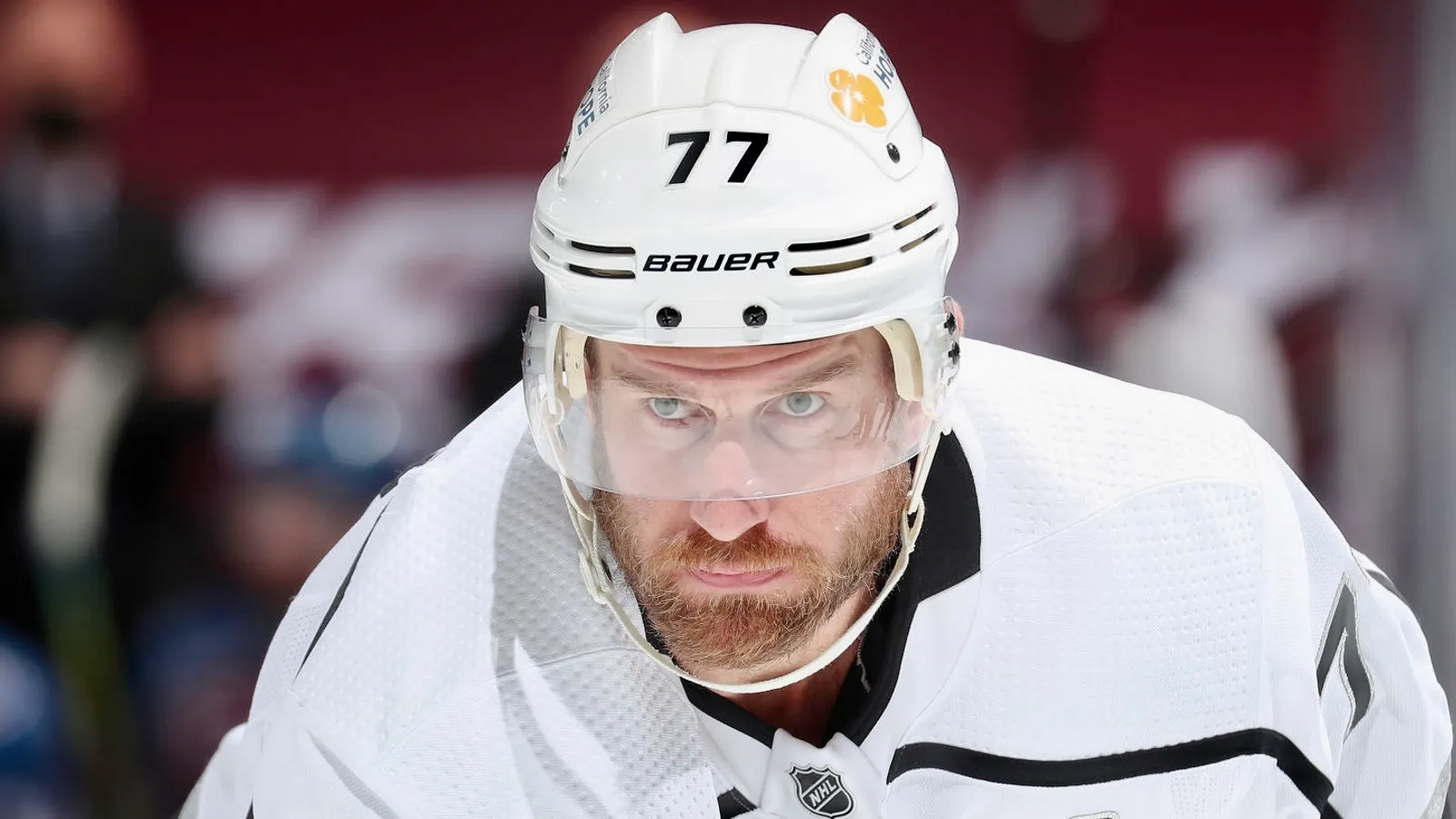
NEWARK, N.J. -- There was a time when acquiring Jeff Carter would have been one of the headline deals of an NHL trade deadline.
Of course, that also was a time when Carter, 36, couldn't have been obtained for a couple of conditional mid-round draft choices.
So while the price Ron Hextall paid to acquire him from the Kings early Monday seems to be fairly modest, it's far from certain what the return on that investment will be. Carter can play center or right wing, and can move up and down the lineup, a trait that could come in handy with all of the injury issues the Penguins have had in recent years. Neither Hextall nor Mike Sullivan has spoken publicly since the trade, so it's not clear where the Penguins plan to use him, at least initially.
If and when injured forwards like Evgeni Malkin and Kasperi Kapanen return, however, Carter seems like a candidate to center a bottom-six line, with Teddy Blueger in the middle of the other.
Carter is not the offensive force he was earlier in his career -- he put up 46 goals and 84 points, both career highs, while playing for Philadelphia in 2008-09 -- but the Penguins don't need him to be a prolific scorer as long as they have Sidney Crosby and Malkin in the middle. He had eight goals and 11 assists in 40 games with the Kings this season, which jells with his reputation for being more of a goal-scorer than a playmaker. Carter also is a capable penalty-killer, as evidenced by his 18 career shorthanded goals.
Carter still skates well, which is imperative for any player in Sullivan's system, and has carried a decent workload, averaging about 16 1/2 minutes of ice time per game this season.
Hextall has said several times of late that he'd like to add some physicality up front, but despite Carter's imposing size -- he's 6 foot 3, 219 pounds -- he does not play a rugged game. He has been credited with 36 hits this season, an average of less than one per game.
Although Carter has a year remaining on his contract, there has been speculation in Los Angeles that he might retire after this one. If he stays for 2021-22, it could have a significant impact on the Penguins' salary-cap situation, although the Kings are picking up half of his $5,272,727 cap hit.
For now, the Penguins are about $3.5 million over the $81.5 million cap ceiling, but have access to $12.68 million of Long-Term Injured Reserve list relief because of the injuries that have sidelined Malkin and Brandon Tanev. That leaves $9.15 million in cap space, some of which must be reserved to cover Malkin and/or Tanev if they return during the regular season.
The stipulation that the Kings would pick up half of Carter's cap hit was laid out when the trade was announced. The conditions under which the draft choices the Kings will receive could change -- they currently are a third-rounder in 2022 and a fourth-rounder the following year -- were not revealed by either club, and will determine just how much of a gamble it was for Hextall to acquire Carter.
The conditions in such a deal usually relate to how the player's new team performs in the postseason. A pick could, for example, move up a round if the club that added him wins the Stanley Cup, or advances to a certain round of the playoffs. It also could hinge on whether the player dresses for a certain percentage of his team's playoff games.
There is, however, no indication that any provision to which Hextall agreed will countermand his vow to not surrender assets that could play a prominent role in the franchise's future unless doing so is absolutely necessary.
Which, obtaining Carter was not.
Given the way his new team has been playing -- and the fact that it should be getting an infusion of major contributors like Malkin, Kapanen and Tanev before the playoffs begin -- Hextall could have reasonably stood pat at the deadline, something that seemed quite possible just hours before the Carter trade was finalized.
The only risk would have been that he might have been criticized for his non-action if the Penguins had unraveled after the deadline. Of course, given that Hextall used to make his living putting his body in front of pucks moving at high rates of speed, the threat of being struck by a few hostile words probably didn't faze him much.
Hextall was assistant GM in Los Angeles for part of Carter's tenure there, so he should have a pretty good feel for Carter's talents and intangibles. He undoubtedly recognizes Carter's contributions to the Kings' championships in 2012 and 2014. Mind you, those were different times, and Carter was at a different stage of is career. He was close to a franchise cornerstone-caliber player then; today, he is a complementary one.
Kind of like another veteran right-handed forward, Bill Guerin, was when the Penguins brought him in at the deadline in 2009. You might remember how that turned out.