
The 2021 season is at the one-tenth mile mark, 16 games deep into a 162-game schedule. So far, the Pirates are 7-9 and a little better than expected. Nobody predicted this team to compete for a playoff spot or even hover around .500, but they’ve hung in there most games and have bounced back nicely from a rough opening road trip. There’s some fight in this club, which is encouraging going forward with this rebuild/build.
It’s been a very mixed bag to get to this point, though. The offense has had some bright spots – Bryan Reynolds, Colin Moran, Phillip Evans, Adam Frazier – and some lumps – Kevin Newman, the center fielders, being without Ke’Bryan Hayes for most of the season. The same goes for pitching. For every JT Brubaker or Tyler Anderson, there has been a Mitch Keller or Trevor Cahill.
For today’s Mound Visit, let’s focus on in the pitching side. Not just at individuals, but at six specific pitches that are either doing better than we’ve seen in the past, worse or just have some untapped potential. Who is making strides early this year, and who is trending in the wrong direction?
And fair warning: Take everything here with a bit of small sample size caution. That could go for basically any analysis piece written before mid-May.
FASTBALL: JT BRUBAKER
During his rise through the Pirates’ farm system, Brubaker was primarily a sinker-slider guy. Someone who worked down in the zone and fit the mold that the old regime was looking for out of their starters. Get ground balls with the sinker and rely on the breaking pitch for whiffs.
For the most part, it worked. Brubaker was the organization’s minor-league pitcher of the year in 2018 and would have been in the majors the following season had it not been for an elbow injury.
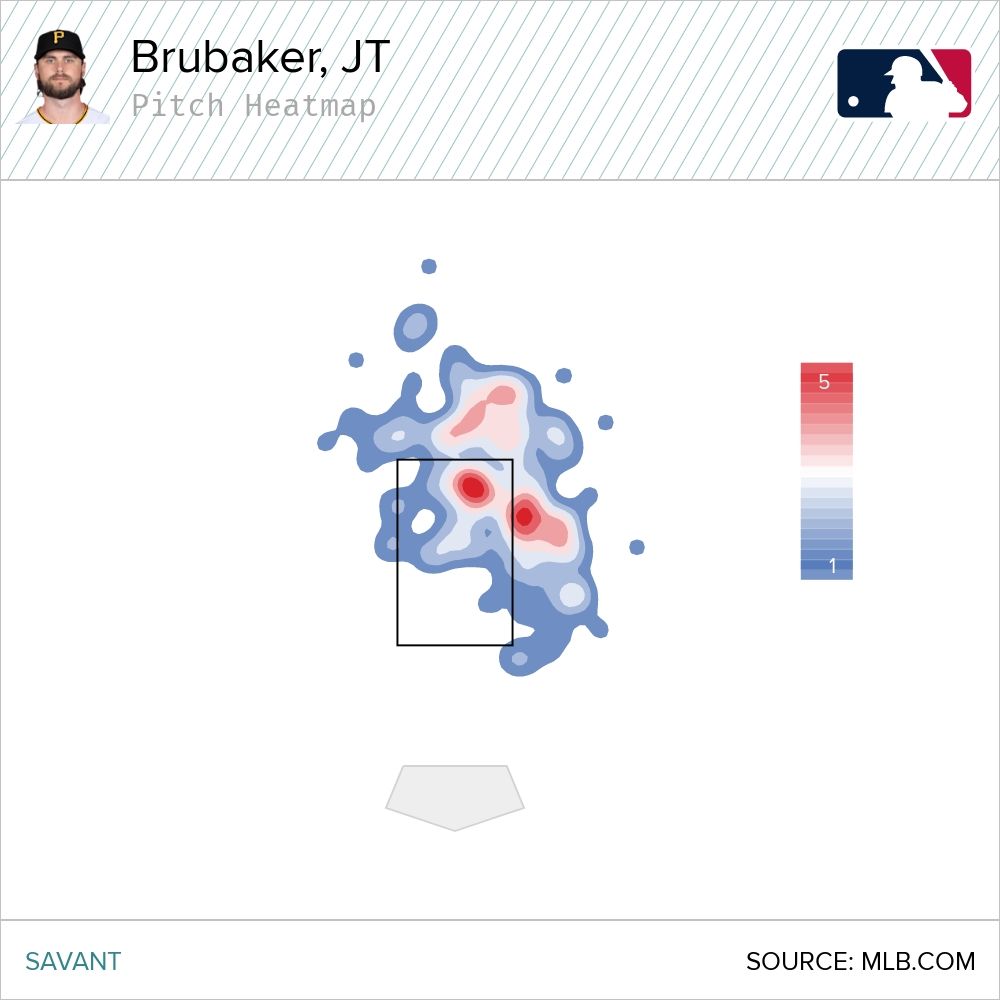
Last year, he reworked on his repertoire, mixing in a four-seamer and curveball more. The overall results were ok – a 4.94 ERA and 91 ERA+ over 47 1/3 innings – but the first foray with the four-seamer didn’t go too well. Batters went 9-for-20 against it, he walked three and plunked three others and it got the lowest whiff-rate of all his pitches (8.3%).
Brubaker added the pitch so he could use the top of the zone more effectively, but the pitch would cut on him at times and fall over the heart of the plate:
BASEBALL SAVANT
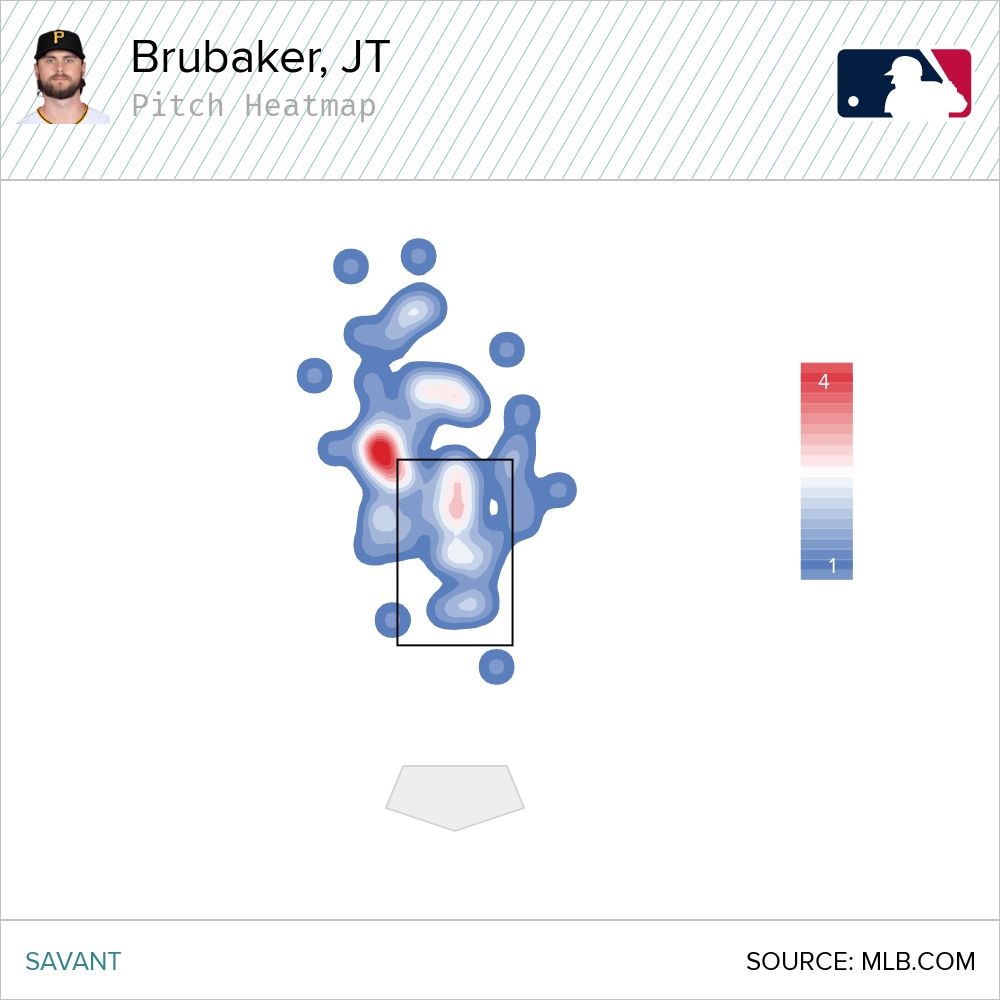
It’s been a different story this year. Not only has he upped his usage on the pitch, throwing it as often as his sinker now, the whiff rate has jumped to 45.5%. He has as many strikeouts on the four-seamer this year as he did all of last season (three), and batters are 0-for-6 against it so far.
And perhaps most importantly: It’s staying on his hand side and not cutting over the plate:
BASEBALL SAVANT
Ideally that red dot would be on the corner instead of just off it, but four-seamers there aren’t going to hurt him, and it will open up the curveball more as a weapon since it tunnels well off it.
Brubaker’s sinker is playing up too this year (batters are 1-for-17 against it) and he’s off to the best start out of any of the Pirates’ pitchers. The sinker and slider are still the primary out pitches, but the four-seamer is letting him use all of the strike zone.
Take Friday’s start against the Brewers. With the game on the line in the third, he faced Travis Shaw, the lineup’s big hitter, and the bases juiced. After a battle, he punched him out with a heater. What was his mentality before that final pitch?
“Here's my best fastball. What are you going to do with it?”
That has to be a pitching coach’s favorite sentence. Brubaker is making strides this year, and could really establish himself as part of the rotation going forward.
SINKER: CHAD KUHL
I’m willing to die on the Chad-Kuhl-has-two-plus-pitches-and-a-fastball-that-isn’t-supporting-them hill. Somebody has to.
It might not be fair to dive too deep into Kuhl’s overall stats since he was still getting some rust off going into the season. Of course the sinker isn’t going to be in top shape after he missed a couple turns in the rotation. But even in his start Sunday, he left way too many fastballs over the heart of the plate.
And here’s what happens to them:
The first Vogelbomb of 2021.
— Milwaukee Brewers (@Brewers) April 18, 2021
We're up 1-0 in the first.#ThisIsMyCrew pic.twitter.com/3T5XOQVda5
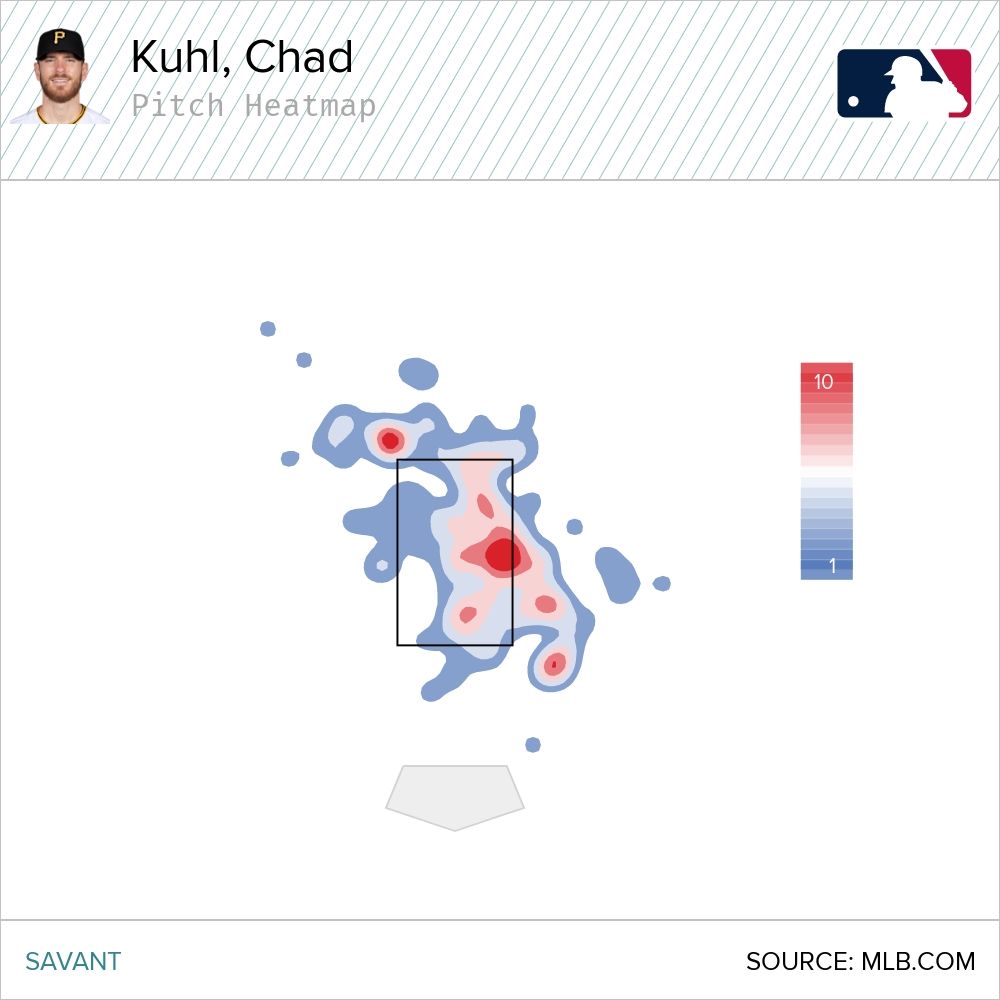
The sinker has been a problem for Kuhl in the past, as I wrote about in a previous Mound Visit, but he’s serving up far more meatballs than usual. Last year, at least most of his sinkers were near that low, inside corner. This year, they’re running, either over the heart of the plate or out of the strike zone:
BASEBALL SAVANT
His fastball has enough problems when he’s hitting the edges. He doesn’t need this.
Kuhl has done better once he gets out of the first inning, and he only walked one Sunday, which is a very good sign after walking 15 in his first three starts. Eight of those free passes were on sinkers, and it’s easier to hold off on breaking stuff when you know the fastball isn’t going to be in the zone.
Kuhl could be a junkballer. Or maybe he’d be better as a reliever. For either to happen, he needs to get more out of his sinker. Right now, it’s not serving his breaking stuff justice.
CUTTER: TYLER ANDERSON
It was pretty clear what the Pirates were looking for innings when they signed Anderson in February. He isn’t going to be part of the club’s long-term plans, but he’s a reliable hand to add to the rotation that could use a veteran and some depth.
His overall stats from his first three starts are only ok (1-2, 4.02 ERA), but that doesn’t really indicate the quality of the outings he’s had so far. If it wasn’t for a pop-up single against a drawn-in infield and Javier Baez’s golf swing homer against a pitch that almost bounced to the plate, the Pirates could have theoretically won all of his starts. If nothing else, that ERA would be a lot lower.
He’s relying on his cutter a lot more this year, going from throwing it a little under 20% the last two years to 35% this year, more than any of his other pitches. Not only has he upped its usage, he’s upped its spin, going from about 2,400 RPM last year to a bit over 2,600 RPM thus far.
He’s also changing up velocities on it, having it range from 81 to 89 mph. In a way, it looks like he’s using it almost as a slider at times, but with the ability to throw it a harder and jam right-handers.
“I feel like it's a pitch right now that I have good feel with, so I'm just going to add and subtract [velocity] a little bit," Anderson said after his last start.
The results so far have been encouraging: Hitters are 5-for-23 against it, and the 82.6 mph exit velocity is the fifth-lowest among the league’s cutters (min. 10 results).
Anderson’s season stats will probably be within arm’s length of what he did last year with the Giants, maybe a little better. If he continues to do well, then the Pirates will be presented with a choice: Try to hang onto him for 2022, or see if they can flip him for a prospect at the deadline. With most of the team’s starting pitching prospects two or three years away, the first option might be worth exploring.
CURVEBALL: LUIS OVIEDO
I’m cheating here. Not just because I’ve already written about Oviedo’s curve in a recent Mound Visit. Not just because Oviedo’s curve really hasn’t changed since then (frankly, there really isn’t anything that sticks out as new when it comes to the staff’s curves).
No, we’re going to talk about how to make Oviedo’s curve play better.
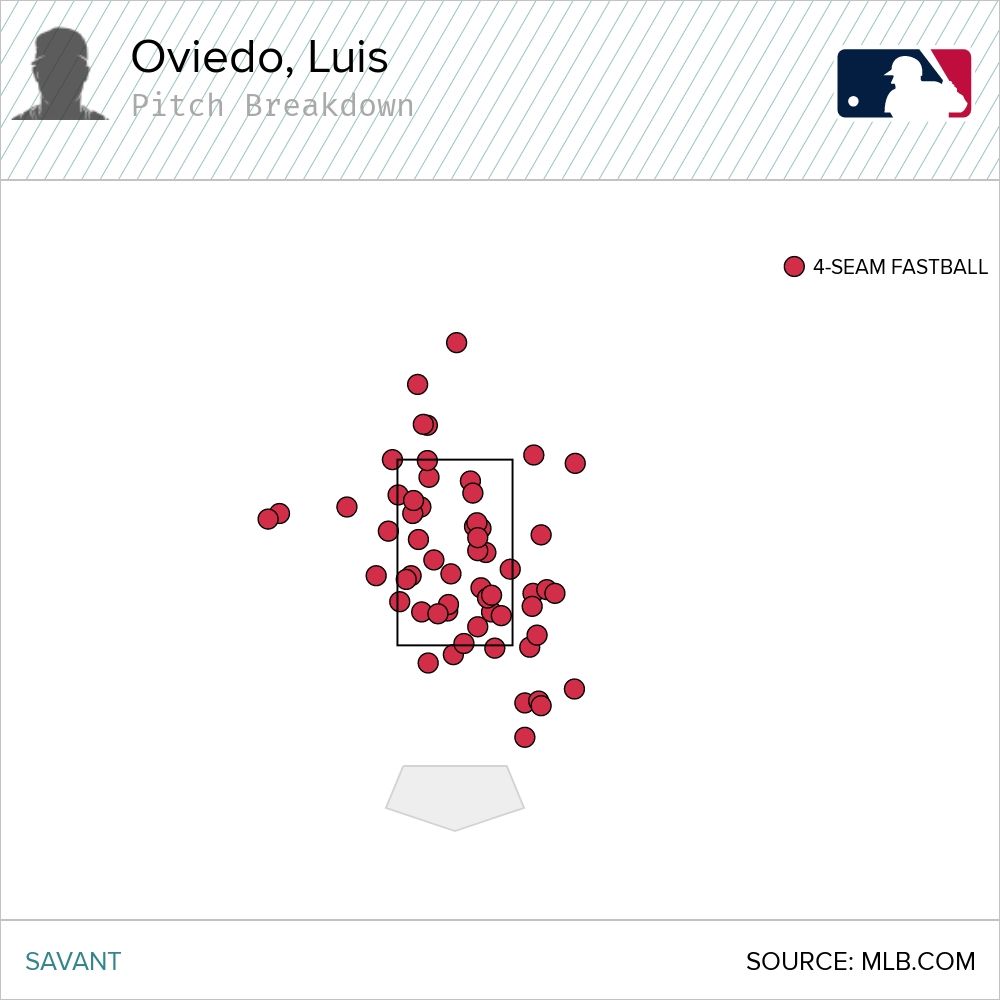
Some of it is going to come with reps and more experience, like tightening up his release point. But perhaps more important, it’s going to be dependent on him using his fastball more effectively:
BASEBALL SAVANT
The good news here is he is throwing strikes. There are plenty of 21-year-olds who would be intimidated being on the big stage and nibble at the zone. Oviedo is attacking. It’s a very good sign.
But look at where those fastballs are. Center cut and over the heart of the plate. When he misses a high target, it’s usually crushed, and he needs that high fastball so his curve can tunnel off it. He gets a ton of vertical movement on his curve, and it has true 12-to-6 potential. Until he can prove that he can throw the fastball up, batters are going to learn to lay off it.
Oviedo is going to go through some growing pains this year, but the stuff and the confidence are absolutely there. It’s going to come down to pitch execution for him. The curve might end up being his third pitch behind the fastball and slider, but it could be his kill pitch to get strikeouts. It’s going to need some support from his other pitches to get to that point.
SLIDER: MITCH KELLER
Going into spring training, Keller appeared to be in position to takeover the front of this rotation, presumably for years to come. Instead, the 25-year-old has been wild and ineffective.
Fastball control is a major issue, but we’ve seen signs of him getting better with his release. The greater concern, at least to this writer, is the slider. He added it in 2019, and it quickly became one of his best two pitches with the fastball (and the order was debatable). It moved, it had good spin, it got whiffs. It’s why people didn’t hit the panic button after his abbreviated rookie season. His peripherals were strong, and the slider was a big reason why.
His spin rate for the pitch has dropped 300 RPMs from 2019 to 2021, going from 2,661 RPM to 2,361. It’s not moving as much and it’s hanging out over the plate too often, like this meatball to Manny Machado in his last start:
Yes, these is some small sample size at work here, but batters hit .158 (9-for-57) against his slider his first two years in the majors with only one home run. So far, they’re 5-for-14 with two long balls. There’s nothing cheap about those hits, either. His xwOBA on the slider is .472, the seventh worst out of 141 qualified pitches (min. 10 results).
Keller has been throwing from a lower arm slot this year, so it is fair to wonder how the lower attack angle is effecting his stuff. Is it a problem where he isn’t finishing pitches? That would explain why the slider is hanging over the heart of the plate instead of continuing to run and why he is having difficulty throwing his heater up.
Keller’s problems seem to stem from an overall lack of command. That can’t be worked around. He has three potential plus pitches, but right now, none of them are moving the way he wants. The Pirates have a lot riding on that right shoulder, and he’s one of a handful of players whose performance this year will impact the franchise long-term. There’s plenty of time to right the ship, but he hasn’t looked like the Keller from his rookie season.
CHANGEUP: DUANE UNDERWOOD JR.
The Pirates traded for Underwood on March 7, so they didn’t get a long look at him this spring. They still had enough confidence to add him to the roster, and so far, he’s pitched well. He’s struck out 13 of the 39 batters he’s faced and has a 2.89 ERA at the first mile-marker of the season. There’s potential for him to stick in the bullpen going forward.
He’s been mixing in a new slider periodically, so he has potential to be the rare five-pitch reliever. But the changeup has been his best pitch, getting seven strikeouts, the lowest average exit velocity out of all of his pitches (89.3 mph) and holding batters to a 1-for-12 clip.
Like any newcomer who has some initial success, there’s always a question of how much of this is due to the change in scenery and how much of it is a change in approach. I’m leaning towards the later. For one, Underwood is using his changeup more than any other pitch (31.8%). He isn’t afraid to throw it to right-handers, but it’s mostly used as a neutralizer to lefties.
Mechanically, he’s raising his glove higher during his windup, bringing it to shoulder level rather than just raising it with his knee.
Whether it’s for that reason or another, his changeup release has been a little further away from his body. Meanwhile, he’s doing a better job hitting the edge of the zone on his hand side, rather than catching too much of the heart of the plate.
Underwood Jr. has always had a good changeup, but it looks like we’re seeing some signs of it becoming a really good pitch that he can lean on more. If nothing else, it’s a different look out of the Pirates’ bullpen from an intriguing new reliever.