
COLUMBUS, Ohio -- In the absence of Sidney Crosby and Evgeni Malkin, the Penguins have powered their way to securing six of a possible eight standings points through their first four games thanks to contributions from nearly every skater in the lineup.
Surprisingly, one of the few skaters that hasn't made much of an impact at all is Kasperi Kapanen.
Kapanen, who has yet to find the back of the net this season, has two primary assists and is the only Penguins forward to appear in all four games without a point at five-on-five.
Point production aside, a look at Kapanen's on-ice metrics wouldn't lead you to believe he has been largely ineffective. With him on the ice at five-on-five this season, the Penguins are controlling 58.8% of the shot attempts and 63.3% of the expected goals, per Evolving-Hockey.com.
It is true that the Penguins have carried play with Kapanen on the ice this season, but that is largely thanks to his trigger-happy linemates, Evan Rodrigues and Jason Zucker.
The concern with Kapanen isn't that he hasn't found the back of the net yet, it's that he's not generating any quality looks for himself. To this point, Kapanen has taken just a single unblocked shot attempt in between, and below the faceoff dots at five-on-five.
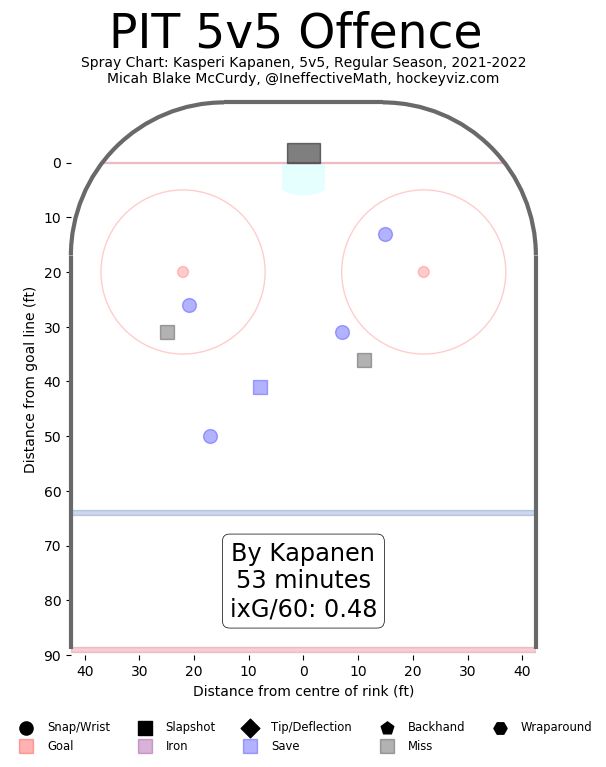
HockeyViz.com
Last season, we learned that Kapanen doesn't drive a ton of offense on his own, but he showed an uncanny ability to capitalize on the chances he was creating, especially off the rush.
Certainly, downgrading from Malkin to Rodrigues at center is going to disrupt the way Kapanen would like to play, but with his blazing speed, why hasn't he been able to create those opportunities for himself?
MISTAKES WITHOUT THE PUCK
To understand why the chances have been so few and far between, we must observe Kapanen's play when the puck isn't on his stick in both the offensive and defensive zone.
The following clip from opening night against Tampa Bay illustrates many shortcomings of Kapanen's cycle game:
On multiple occasions in the same sequence, Kapanen inexplicably exited the offensive zone, taking himself completely out of the play despite the puck never coming across the blue line to the neutral zone. The first instance caused him to be late to support Zucker down low, and the second instance forced the Penguins into a low-danger attempt from the boards.
In between his mishaps, Kapanen could be found gliding around on the opposite side of the ice as the puck, waiting for a teammate to make something happen for him.
A similar sequence transpired in the Penguins' home opener against Chicago:
Kapanen swooped the puck along the boards and quickly dropped a pass to Zucker, who was below him. Again, Kapanen got the puck off his stick and glided straight out of the play toward the point before he eventually wound up on the other side of the ice. Instead of trying to cut back through traffic, Kapanen left Zucker unsupported and it wasn't long before Chicago regained possession.
Earlier in the same game, Kapanen had an opportunity below the goal line to use his body to separate a Chicago player from the puck, but instead he went outside of the Chicago player and made a weak attempt to tie him up. Seconds after, Zucker found himself outnumbered in a board battle while Kapanen apathetically waited for the puck to pop out on his side. Spoiler alert: it didn't.
These may seem like little things, but they make all the difference between extending zone time and creating chances off the cycle versus having to get back on defense.
On the defensive side of the puck, Kapanen's defensive results have been alarmingly strong through four games, though I'd be shocked if it stays that way for much longer based on some of his tendencies.
Most alarming of them all is Kapanen's tendency to completely ignore his duty on breakouts from below the goal line. It is the strong side winger's responsibility to get to the half-wall as an outlet for the defense when breaking the puck out, yet in the Penguins' most recent contest against Dallas, Kapanen failed to do so. In fact, he didn't even attempt to do so, and the Stars were ultimately able to extend their zone time:
It's no secret that Kapanen's objective in the defensive zone is to hang out around the blue line looking to pick off cross-ice feeds for rush opportunities the other way, but his in-zone coverage can be downright abhorrent.
In the Penguins' second game of the season against Florida, Kapanen got caught puck-watching and gliding around the zone while the Penguins desperately needed a clear. Hardly ever have I called out a player for their effort, but Kapanen's work ethic in the defensive zone is an abomination, and a great example of what not to do for young hockey players:
MISTAKES WITH THE PUCK
When the puck has been on Kapanen's stick, he hasn't been using his speed to his advantage.
Instead of blazing to the outside of lumbering defenders and subsequently driving to the net, Kapanen almost always pulls up at the faceoff circle and waits for support, typically resulting in mediocre one-timers:
Nobody is expecting him to be a power forward, but he needs to start taking the ice available to him when flying down the wing:
LACK OF CREATIVITY
On top of everything we've already covered, Kapanen simply hasn't been very dynamic with the puck on his stick. Often times he has trouble getting the puck to settle and his creativity suffers for it.
In the next clip, Kapanen entered the zone with momentum and received a pass from Rodrigues, only to maintain his speed and fire a shot into the defenders rather than attempting to cut to the slot, or make any sort of move:
Lastly, we get a look at Kapanen retrieving a puck near the point in the offensive zone with speed and space along the left wing boards. Instinctually, play makers will hang onto the puck an extra second to pick their head up and scan their options. Not Kapanen. He retrieved the puck and whipped it back below the goal line without ever recognizing the space he had if he would have hung onto the puck:
None of this is to suggest that Kapanen is horrible. He's not. But, the reality is that there are a plethora of little details missing from his game that would go a long way toward solidifying himself as someone that can be consistently relied on for offense.
The Penguins can handle his defensive shortcomings, but only if the offense shows up sooner rather than later.