
Mike Tomlin often likes to tell his players that they can't warm up to playing in a game in the NFL.
The message is a simple one. If you're not prepared to play from the start, you might find yourself in a pretty big hole by the time you are.
But Tomlin might want to come up with a new message for his current team, one that stresses the point that games are 60 minutes -- or more -- in length.
The Steelers are allowing just 7.8 points per game in the first two quarters of their games this season, a total that ranks third in the NFL. In the second half, however, they're allowing 13.4 points per game, 25th in the league.
And with an offense that's still finding its way, it's led to the Steelers being outscored 107-89 after halftime this season and plenty of tense moments.
"It's a game of momentum. Once it slips, it's hard to get it back," said linebacker Joe Schobert. "At halftime, obviously there's a lull. We've got to focus on coming out in the second half as the first half."
It's something the Steelers (5-3) are working to rectify as they prepare to host the Lions (0-8) Sunday at Heinz Field.
"If we did (have the answer), we'd obviously try to halt it because we don't like it either," defensive coordinator Keith Butler said. "We're going to do the best we can. We need to start out better in the second half. That's the big thing for us. We've done a good job in terms of start of the game. What we've got to do when we come back out (after halftime), is that we've got to win the first couple of series."
Part of the issue for the Steelers has been that because the offense isn't at all explosive, it's allowed opponents to stick with their game plan, even when down at the half.
For example, in Week 6 win over the Seahawks, the Steelers led 14-0 at the half, by Seattle came out running the ball in the second half -- much to surprise of the Steelers -- and got themselves back into the game. The Steelers eventually adjusted in the fourth quarter, but not before the Seahawks did enough to push the game into overtime, where T.J. Watt's strip-sack led to a 23-20 victory.
Last Monday night against the Bears, the Steelers led 20-6 entering the fourth quarter, only to have Chicago stick to script and eventually take a 27-26 lead, forcing Ben Roethlisberger to lead a late game-winning field goal drive.
"Finishing," Cam Heyward said Thursday when asked what the defense needs to do better. "I know we weren’t great in the run game, containing the quarterback. They really got started in the second half with the run game. And then just big plays at the end. As a defense, we’ve got to be better, create more turnovers, more sacks. But to do that, you’ve got to stop the run."
To that point, four of the Steelers' last five opponents -- the Packers, Broncos, Seahawks and Bears -- have rushed for 100 or more yards, something once considered a rarity against Pittsburgh. The one team that didn't top 100 yards on the ground in that stretch was the Browns in Week 8 in a 15-10 win by the Steelers.
Yet Cleveland, which rushed for 96 yards in that loss, is second in the NFL in rushing at 160.2 yards, less than a yard behind league-leader Baltimore in that statistic.
So, the Steelers are capable of slowing good rushing attacks -- they just have to be focused on doing so, something Tomlin has admitted might not have been the case in wins against the Seahawks and Bears.
"At certain points during the game, you felt like the game circumstance was going to minimize (the running game)," Tomlin said. "But as the game unfolded, it didn't. We’ve got to be better there. We’ve got to have a more comprehensive plan. We can't allow those things to keep us off-balance and minimize some of the things that we like to do in terms of wreaking havoc on the quarterback or on the offensive unit."
Perhaps in previous years, being up 14 points in the second half might have deterred opponents from running the ball. But because the Steelers' offense isn't all that dynamic -- averaging just 20.1 points per game itself -- opponents are more willing to stick with the running game. And that, in turn, allows them to then throw the ball in easier situations, even late in games.
It keeps the Steelers in a guessing defensively, which is not what they want. They want to force opponents into passing situations and then rush the passer -- which is what they're built to do best.
"Sometimes it's a guessing game," said Butler. "You've got to be careful and hold down good quarterbacks the best that you can. ... The thing we've got to do is take care of those runs that are unexpected. I've got to do a better job of coaching them."
Tomlin has been emphasizing the issue with his defense, as he does with all mistakes.
"That's Coach T's first thing he says at the beginning of the week when we go over (the game)," Schobert said. "The mistakes and learning corrections from the game before. He wouldn't be the coach he is without being honest. That's all he talks about.
"We're playing well. We just have to execute the full 60 minutes better. There's a couple of times throughout the game, at various parts of the defense, like Coach T says, there are popcorn mistakes. It's a 'My bad.' There's a brain fart on one play. We have to focus on eliminating those and stay locked in and focused for the whole 60 minutes."
THE INJURY REPORT
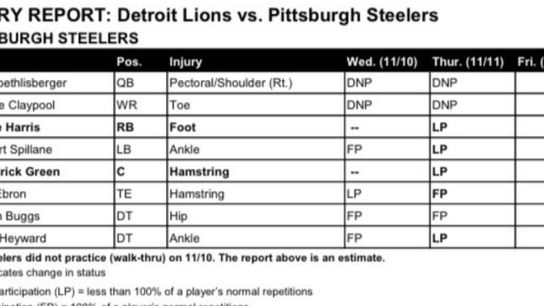
PITTSBURGH STEELERS
A few additions to the injury report release following Thursday's practice. Najee Harris (foot) was a limited participant as was center Kendrick Green (hamstring). Eric Ebron (hamstring) and Isaiah Buggs (hip) returned to full participation while Chase Claypool (toe) and Ben Roethlisberger (pectoral/shoulder) did not practice. Robert Spillane (ankle) and Cam Heyward (ankle) were both limited participants.