
ALTOONA, Pa. -- The question that often comes up is, "Who's advising these people?" Because to the outside world, their decisions don't seem to make a great deal of sense.
Take, for instance, Penn State left tackle Rasheed Walker. He announced Monday that he is giving up his final two years of college eligibility and declaring for the NFL draft, despite enduring a tough season in which he did not play well and saw his draft stock plummet.
It’s only crazy until you do it. AGTG pic.twitter.com/KYfFTecYMl
— Rasheed Walker (@Cin5oTre3) January 3, 2022
Prior to the season, Walker was considered to be a potential first-round draft pick. Here's a mock draft that had him getting picked 11th overall.
It made sense. Walker plays left tackle, one of the most important positions in football, and has tremendous size at 6-foot-6, 325 pounds,
Why wouldn't he be a potential first-round pick?
But something happened over the past few months. Walker struggled -- as did Penn State's entire offensive line -- and turned out to be really the most disappointing player on the Nittany Lions this past season. Then he got hurt, missed the final three games and was on crutches at the Outback Bowl.
All the way back in early October, Walker was listed as one of the 10 most disappointing NFL draft prospects by Pro Football Focus. Here's what they wrote about him:
Walker is one heck of a physical specimen at 6-foot-6 and 320 pounds. He’s got the feet of a man 100 pounds lighter, but even after four years at Penn State, we still haven’t seen that in pass protection. He was nothing short of a problem at left tackle in games against Wisconsin and Auburn this year. His 63.6 pass-blocking grade is even lower than his 67.9 in 2020 — and that’s the wrong direction to be going as we head into the draft.
What did this season do to Walker's draft stock? Well, at best he's now considered a potential mid-round pick, and possibly dropping as far as the sixth round. Here's a look at his draft stock from NFL Mock Draft Database.
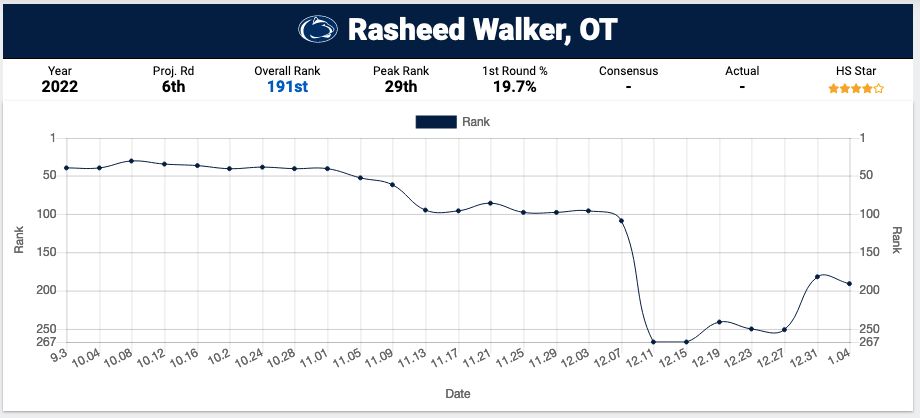
Throughout the history of college football, we've sort of always heard the same thing about players turning pro early. Which has been, if you're not going to be drafted in the first or second round, you might as well come back to college and see if you can improve your stock.
But more and more in recent years, that line of thinking has gone out the window. Players projected to be mid- or late-rounders have decided to leave college early, and even some players who really weren't considered strong draft candidates at all.
Remember Kevin Givens? He had a decent career as a defensive tackle at Penn State, then turned pro a year early and didn't get drafted in 2019. He made a risky decision, but Givens wound up making the practice squad with the San Francisco 49ers in 2019, and has spent the past two seasons on their active roster. He's played pretty well at times and certainly is earning a lot of money -- $610,000 last season and $685,000 this season.
Sure, for every Kevin Givens where things do work out, there are other players who turn pro early and don't get drafted, then things don't work out and they filter out of football.
These players are betting on themselves, so they decide to roll the dice and see how things shake out in the pros.
Walker isn't the only one who will be doing that from the 2021 Penn State team.
So far, these are the other Penn State players who have announced they're turning pro despite having college eligibility left (some could be super seniors), plus where they are projected by NFL Mock Draft Database:
* LB Brandon Smith: 2nd round, 61st overall
* LB Ellis Brooks: 6th round, 204th overall
* LB Jesse Luketa: Undrafted free agent, 292nd overall
* WR Jahan Dotson: 1st round, 31st overall
* DE Arnold Ebiketie: 3rd round, 66th overall
FYI: Safety Jaquan Brisker (1st round, 25th overall) does not have any eligibility left and is projected to be a high draft pick.
As you can see, guys like Brooks and Luketa join Walker in having lower draft stock, yet they still decided to move on and try their luck in the pros.
Why? Well, that varies with every individual.
Some are just tired of being in college and dealing with all that comes with that lifestyle. Many have already graduated. Some feel like they are way better than their draft stock would indicate (Walker probably falls into that category). And some are ready to try and get paid, even if it is only as a member of an NFL practice squad (where guys can make more than $100,000 for an entire season).
One thing that helps Penn State players in particular is that many of them test very well for scouts at pro day or the NFL combine. The Penn State program has become very well known for having guys test well, and that can increase their draft stock more in one afternoon than playing another entire season of college ball.
Injuries can play a factor in decisions, too. Walker got hurt late this season, so he might have just figured he'd turn pro now instead of risking another injury next year in college. Then again, had he returned and played well next year, you'd think he would have significantly improved his stock, in large part because there really isn't anywhere he could go than up at this stage.
The biggest unknown is always this: Even if a player does come back to college for another year, there's no guarantee he will improve his draft stock. Yes, players such as Dotson did that in a big way this season, and Pitt quarterback Kenny Pickett became the poster boy for having a big final season and drastically improving his stock.
But for others, they already may have peaked in college and have developed about as much as they're going to develop at the level. For those guys, especially the ones willing to bet on themselves, they figure they might as well at least try to get paid instead of giving it the old college try for one more year.
Football is a violent sport, and all players have a shelf life in the pros. A short shelf life, at that, for probably 75 percent of NFL players. We've gotten to the point where, through opting out of bowl games or turning pro early, many players have decided that it's their bodies, they know the risks and they want to maximize their opportunity by turning pro as soon as they can.
It will work out for some. It will not work out for others.
But it's their choice. And the trend now is that more and more players are making that choice to turn pro early, which is a trend that probably will continue in the coming years.