
"No one likes their time and space taken away," Mark Friedman told reporters, still wearing his compression shorts with velcro that hold his hockey socks in place, following the Penguins' 7-2 drubbing of the Rangers in Game 4 of the opening round of the Stanley Cup playoffs at PPG Paints Arena Monday night.
Friedman, who picked up his first career Stanley Cup playoffs goal during the Penguins' onslaught, understands that chances like the one he scored on don't come around if you aren't dictating terms, or like he said, taking away the opposition's time and space.
Coming into this series, it seemed likely the Rangers' potent and dynamic transition game -- mainly their ability to create and score on odd-man rushes -- would give the Penguins fits. It was a common theme in several of the games between the two teams during the regular season. The Penguins sputtered down the stretch, whereas the Rangers finally seemed to be firing on all cylinders and not counting on Igor Shesterkin to carry the burden of their inability to control play at five-on-five.
Aside from Game 3, where the Penguins filled the net enough to cover for it anyway, and bits and pieces of Game 2, the Penguins have done a wonderful job of not only controlling the pace of play, but making sure they weren't putting themselves in positions that could spring odd-man rush opportunities for the Rangers.
"I thought tonight might've been our best effort as far as our play away from the puck," Mike Sullivan said following the victory. "I thought we did a better job of limiting the odd-man rushes. We were on the right side of the puck for most of the night, trying to make it hard for the Rangers to get quality looks ... They've got some dynamic players offensively. We've gotta do our best to try to make them work for their opportunities."
He concluded by saying it was the best the Penguins have played on the defensive side of the puck all series.
Yeah ... just look at the unblocked shot attempts the Rangers mustered Monday night (or lack thereof):
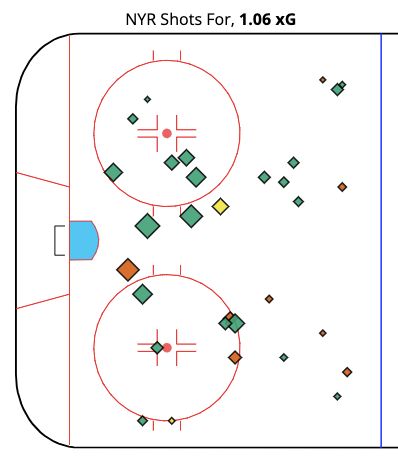
Evolving-Hockey
Squares are scaled to their expected goal value. Yellow = goal, green = shot on goal, orange = miss.
That's a downright staunch performance on any stage, but even more impressive given it's, well, the playoffs, and the opposition would presumably be at the top of their game as to not get pushed to the brink of elimination. The Penguins allowed just 2 high-danger chances against during all-situations, and only 1 at five-on-five, per Natural Stat Trick.
Compare that to when the Penguins were letting the Rangers waltz up the ice with ease just a month ago:
Directly after a faceoff loss, all three Penguins forwards retreated toward the blue line instead of applying any sort of pressure, at least until it was too late. By the time Rickard Rakell even got within the vicinity of the puck-carrier, a passing-lane to the weak-side streaker had already opened up. The Rangers gained the offensive-zone completely uncontested, and upon entry, Mike Matheson's gap was far too loose. It allowed Andrew Copp enough space to slip a pass to the slot for Artemi Panarin, who was wide-open because Chad Ruhwedel got turned around.
We saw the polar opposite of that Monday night:
After Justin Braun poked the puck away from Bryan Rust, the Penguins' forwards were caught deep in the zone with the Rangers looking to get up ice. Rust immediately rushed the puck-carrier, and both Jake Guentzel and Evgeni Malkin sprinted to get back from below the goal line and clog up the center lane. Malkin overcompensated a tad, and wasn't able to take away the cross-ice pass, but their back pressure provided a safety-valve for Friedman to pinch on Panarin. In doing so, Malkin was still close enough to scoop the puck up and get right back on the attack.
That might seem like a poorly executed attempt to break out of the zone by the Rangers. It was, because the Penguins' immediate back pressure forced them to make a decision with the puck quickly, but also because the Penguins had just spent the entire shift wearing them down with possession in the offensive-zone.
"I think the way that we backchecked tonight definitely helped us in that area," Sidney Crosby said after the game when asked about the Penguins' ability to limit odd-man rushes.
Sullivan elaborated a bit more than the captain when asked the same thing: "Most good teams, defensively, are gonna take the rush away. They're gonna have numbers back, they're gonna back pressure on the puck, they're gonna track to the slot."
All three items prevalent in the clip above.
The cohesiveness of each five-man unit and the awareness of each individual skater has also allowed the Penguins' defensemen to get involved in the play down low, as well as being able to make calculated pinches to sustain pressure:
With a quick rim around the boards, the Penguins found three of their skaters, including defenseman Marcus Pettersson, below the puck, but Kris Letang executed a pinch to perfection to hold the blue line before instantly sending the puck back where it came from and darting to the slot. The pass to him got broken up, but Malkin, who had been hanging back, activated on the loose puck and kept the pressure on the Rangers. Moments later, Pettersson executed a pinch of his own to keep the play alive. That's what Sullivan is referring to when he talks about grinding down the opposition.
No matter how calculated, defensemen are going to get handcuffed with the puck at the blue line. It's all about how you recover from it:
The puck bounced right over Matheson's stick and into the neutral-zone as he attempted to hold the line along the wall. He transitioned quickly to prevent getting beat by the checker, and once he corralled the puck, he remained calm, made sure to get the puck in a safe position, scanned the middle of the ice with a shoulder check, then blasted the puck against the grain and off the boards, right back toward the offensive-zone. Keeping the puck out of danger with those hard bank-passes has been crucial to the Penguins keeping the pressure on up ice.
And for as well as they've played overall, it still feels like there's an even crisper, more precise level for them to reach. Regardless, Sullivan is thrilled with the team's buy-in right now.
"These guys, they're on the same page," Sullivan said. "There's a commitment to play the right way, and they're helping one another out there. We talk a lot about collective effort, and that's the team-game we need to have."