
CRANBERRY, Pa. -- Fewer than two months after Opening Night, it feels like the Penguins have endured three different seasons in one.
They came out of the gates hot, rolling to a 4-0-1 record through five games.
Then, they went on to lose their next seven games, picking up just one standings point in the process.
Since that point, they've gone 10-2-2 and now sit in third place in the Metro Division with an overall record of 14-8-4.
It's hard not to think the Penguins' record could be considerably stronger if not for their lackluster special teams through the first month of the season and, mainly, a power play that isn't anywhere close to the level it needs to be, even if they are showing some life of late.
The Penguins have been one of the league's better teams at 5-on-5 this season, specifically on the attack. Here's how they grade out, per Evolving-Hockey:
• Goals for %: 55.3% (8th)
• Expected goals for %: 55% (6th)
• Goals for per hour: 3.03 (4th)
• Expected goals for per hour: 3.13 (4th)
• Goals against per hour: 2.45 (15th)
• Expected goals against per hour: 2.56 (12th)
Few teams around the league are doing as good of a job as the Penguins at creating chances from the net-front and slot area, as evidenced by HockeyViz:
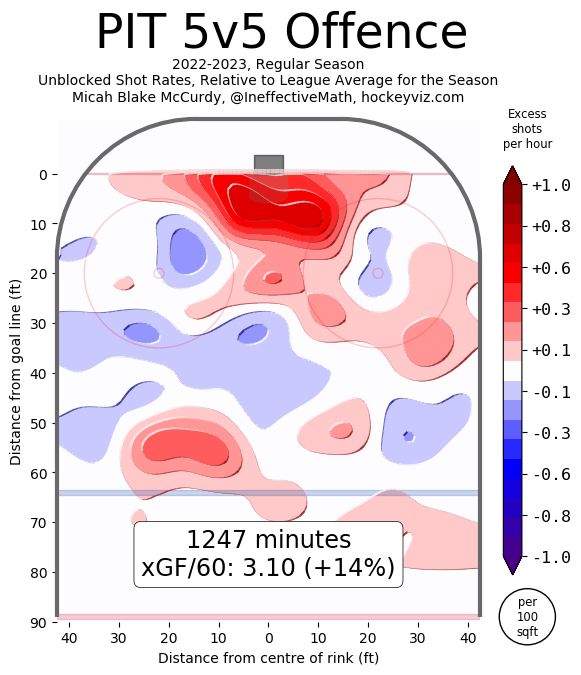
HockeyViz.com
The darker the red, the more attempts the Penguins took from that area relative to league-average, and the darker the blue, the fewer attempts the Penguins took from that area relative to league-average.
And while the Penguins haven't quite scored at the rate you'd expect based off the quality of their chances, they've mostly done a good job of capitalizing on them as only three teams are scoring more frequently during 5-on-5 play.
Sidney Crosby leads the league in 5-on-5 points with 23. Crosby, Evgeni Malkin and Jake Guentzel all rank within the top 23 NHL skaters in 5-on-5 points per hour, and Jason Zucker isn't far behind them in 37th. Then there's Rickard Rakell, who ranks second on the Penguins with seven goals at 5-on-5 and has one of the greatest impacts toward his team's ability to generate quality offense among league forwards to this point of the season.
This team is just fine offensively at 5-on-5. The power play, however, is clicking at just 18.4% this season and ranks 26th. They have scored a power-play goal in three consecutive games, but that comes after six games without one. If they're able to figure things out on the man-advantage, it would likely push this team over the top as one of the biggest offensive threats in the league.
Defensively, the Penguins have taken a step back from where they were last season in both the rate at which they allow goals against and quality chances against at 5-on-5, but they have been trending in the right direction. At the end of October and through stretches in November, they really struggled to limit opponents from shooting in the slot and around the net. For the entirety of the season, though, they're doing a good job of taking away options in the slot compared to the rest of the league:
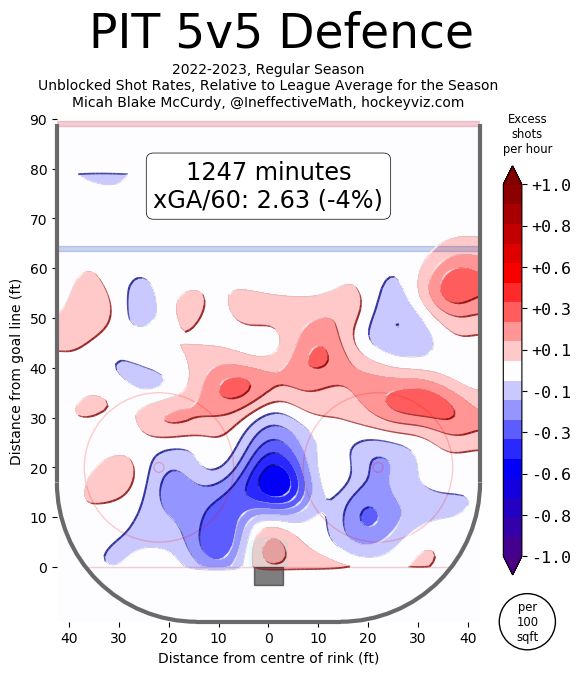
HockeyViz.com
The darker the red, the more attempts the Penguins allowed from that area relative to league-average, and the darker the blue, the fewer attempts the Penguins allowed from that area relative to league-average.
Part of the issue defensively early on could be chalked up to a couple of new additions in Jeff Petry and Jan Rutta going through an adjustment period, as well as Brian Dumoulin struggling before being taken off the top pairing. The team in front of them was simply flat at times, so that wasn't helping the cause, either.
It'd be nice to see the Penguins continue their upward trend of solid defensive work, but it's not going to be the end of the world if they hang around this level for most of the season. As I noted, they've got the offense to cover it and then some.
The penalty-kill, rocking an 81.7% success rate this season, now ranks seventh. Teddy Blueger has had a monumental impact on it since returning from injury, but the rest of the personnel deserve credit, also, for coming together and actually working as a unit to be effective.
Tristan Jarry is on a 7-0-1 heater right now and has really turned his season around after giving up three or more goals in seven consecutive starts at one point. Overall, he boasts an 11-3-3 record with a .919 save percentage and 3.21 goals saved above expected based on the quality of chances he has faced.
Should Jarry settle in at a slightly above-average level, I have to imagine the Penguins will be in good shape moving forward.
Let's take a trip around the Metro Division for a quick look at the other seven teams and how their seasons are unfolding.
All bulleted stats are 5-on-5 and as of Dec. 7.
COLUMBUS BLUE JACKETS (8-14-2)
• Goals for %: 41%
• Expected goals for %: 43.8%
• Goals for per hour: 2.47
• Expected goals for per hour: 2.29
• Goals against per hour: 3.55
• Expected goals against per hour: 2.95
I had the Blue Jackets in the "Basement-Dwelling" category in my preseason rankings and that's exactly where they land right now, rounding out the division in eighth place. At the time, I said Johnny Gaudreau's presence combined with budding star talent in Kent Johnson and Cole Sillinger wouldn't be enough to compensate for other deficiencies around the lineup. That was before they got absolutely decimated by injuries.
Zach Werenski's out for the year, Jake Bean's going to miss the majority -- if not all -- of the rest of the season, and Jakub Voracek just made it known that he's dealing with lingering symptoms of a concussion. Naturally, Erik Gudbranson has stepped into a larger role, logging 26 or more minutes on several occasions. It has been a disaster. He's grading out as one of the worst skaters in the entire league while the Blue Jackets are getting outscored, outshot and out-chanced to jarringly gargantuan degrees with him on the ice. Only three and three-quarter seasons to go for him at a smooth $4 million cap hit.
Joonas Korpisalo has been average in between the pipes, but Elvis Merzlikins has allowed 11.2 more goals than expected and is hurting the Blue Jackets' already slim chances of earning standings points.
There are brighter days ahead for this franchise, but they aren't particularly close.
PHILADELPHIA FLYERS (9-12-5)
• Goals for %: 46.8%
• Expected goals for %: 42.8%
• Goals for per hour: 2.15
• Expected goals for per hour: 2.19
• Goals against per hour: 2.44
• Expected goals against per hour: 2.92
Carter Hart has been a top-five goalie this season and the Flyers are still fumbling the bag. They, too, are another case of an already-weak roster further weakened by injuries. Sean Couturier won't play until 2023, at the earliest, and Ryan Ellis won't play at all until next season.
When your best forwards are Kevin Hayes, Travis Konecny and Cam Atkinson, well, that's obviously not going to cut it. There isn't any star power on this team. On the blue line, Rasmus Ristolainen has been better but still nowhere near good enough, and Tony DeAngelo has been a predictable disaster in his own end without the high-end offensive production he provided previously with the Rangers and Hurricanes.
With the Flyers continuing to give up a ton of quality looks to their opponents, it's fair to wonder how long Hart will be able to hold up before crumbling to the workload. If and when that time comes, things are going to get even worse than they already are for the Flyers.
WASHINGTON CAPITALS (11-12-4)
• Goals for %: 46.5%
• Expected goals for %: 48.8%
• Goals for per hour: 2.16
• Expected goals for per hour: 2.48
• Goals against per hour: 2.48
• Expected goals against per hour: 2.58
The Capitals are at serious risk of missing the playoffs. They've played as many games as any team in the Eastern Conference, but have more standings points than all but four teams: Buffalo, Philadelphia, Ottawa and Columbus. 37-year-old Alex Ovechkin's on pace for close to 40 goals, but he doesn't impact offensive generation the same way he once did, and that's been a problem in the wake of injuries to Nicklas Backstrom and Tom Wilson. T.J. Oshie missed a chunk of time, as well.
Few teams are having a tougher time scoring 5-on-5 goals than the Capitals, and that's a large reason why they have a -11 goal differential despite Darcy Kuemper turning in a solid, if unspectacular, performance to this point. They should be in line for some positive regression when it comes to their 7.47% shooting percentage, but it's not going to be enough to turn the season around.
I predicted the Capitals would teeter on the edge of a playoff spot, but they're looking more and more like a whole lot of blah than anything else even if they do get healthy. They haven't won a playoff series since they hoisted the Stanley Cup in 2018. It's looking like that will be the case for another year.
NEW YORK RANGERS (12-10-5)
• Goals for %: 50.5%
• Expected goals for %: 52.5%
• Goals for per hour: 2.48
• Expected goals for per hour: 2.74
• Goals against per hour: 2.43
• Expected goals against per hour: 2.48
It turns out the Rangers aren't that great when Igor Shesterkin isn't playing out of his mind. Who knew? Don't get me wrong, Shesterkin has been solid, but he hasn't been anywhere near his performance from last season. The Rangers have actually improved quite a bit at 5-on-5 from where they were last season, at least in terms of controlling quality chances at both ends, but they aren't vastly over-shooting expectations. Combine that with Shesterkin coming back to Earth and you get the middling Rangers, who have a modest +2 goal differential through 27 games. It seems as though Gerard Gallant's seat is warming up if it's not burning hot already.
Unlike the Capitals, the Rangers' inevitable shooting percentage rebound should help solidify them as a playoff team, but without significant strides from Alexis Lafreniere or Kaapo Kakko, the Rangers are likely too top-heavy to do much damage without Shesterkin at a Vezina-caliber level.
NEW YORK ISLANDERS (16-11-0)
• Goals for %: 54.5%
• Expected goals for %: 46.4%
• Goals for per hour: 2.56
• Expected goals for per hour: 2.62
• Goals against per hour: 2.14
• Expected goals against per hour: 3.02
Similar to the Rangers last season, the Islanders are outperforming expectations thanks to an incredible run in goal. Ilya Sorokin has solidified himself as one of the premier goalies in the league, as he has saved 20.1 goals more than expected this season. That mark is No. 1 across the league this season, and more than twice the total of the goalie in seventh place.
Unlike past seasons under Barry Trotz in which the Islanders were among the league's better defensive teams, the rate at which the Islanders are allowing expected goals against at 5-on-5 this season is higher than every team except for the Ducks. If Sorokin doesn't stay at this level for the entirety of the season, the Islanders will be on the fringe of the playoffs as their chance-generation and goal-scoring at 5-on-5 rank toward the middle of the pack.
Of course, if Mat Barzal, who has three goals and 25 assists in 27 games, starts to fill the net a little bit, it would go a long way toward relieving some goal-scoring burden for the Islanders' complementary players.
CAROLINA HURRICANES (14-6-6)
• Goals for %: 55%
• Expected goals for %: 59%
• Goals for per hour: 2.44
• Expected goals for per hour: 3.13
• Goals against per hour: 2
• Expected goals against per hour: 2.18
The Hurricanes are once again one of the best teams in the league at controlling the quality of chances at both ends of the rink. Their fast-paced, go-go system allows them to insulate the dangerous areas of the ice in their own end in addition to creating quite a bit of looks of their own with a funnel-pucks-to-the-net mentality. Interestingly, they are scoring 0.69 fewer goals than expected every hour they play at 5-on-5, which could simply be due to spamming as many shots as possible rather than worrying about setting up many pretty plays.
Assuming the Hurricanes continue to get above-average goaltending while playing a staunch defensive game, their disappointing goal-scoring rate shouldn't be too much of a concern unless they run into a team that's figured out how to break them down defensively. Jaccob Slavin trudges on as a legitimate No. 1 defenseman while Sebastian Aho, Andrei Svechnikov and Martin Necas head a solid group of forwards up front.
As expected, the Hurricanes pose themselves as one of the biggest threats to the Penguins this season.
NEW JERSEY DEVILS (21-4-1)
• Goals for %: 66.4%
• Expected goals for %: 61.8%
• Goals for per hour: 3.37
• Expected goals for per hour: 3.31
• Goals against per hour: 1.71
• Expected goals against per hour: 2.05
Where in the world did this wagon come from? Jack Hughes has arrived to superstardom at the perfect time, as he's complemented by the likes of Jesper Bratt and Nico Hischier up front. Don't forget about Tomas Tatar, who isn't putting up a ton of points but is having a great impact on the Devils' ability to control play going both ways. On the back end, Dougie Hamilton, John Marino and Damon Severson have formed the best trio of right-handed defenders in the league, and Jonas Siegenthaler has broken out from a solid depth defender to a driving force over on the left side.
The Devils weren't nearly as bad as their record indicated last season, they just received absolutely putrid goaltending. That was the biggest question I had about them coming into this season, but offseason addition Vitek Vanecek has stabilized them in goal with 5.39 goals saved above expected.
Sitting in first or second in every significant statistical category at 5-on-5, the Devils are on track to be one of the most dominant teams of the stats era. Whether or not you believe they're capable of playing like this for the duration of the season, they are a serious problem for the entire Eastern Conference ... so long as their goaltending continues to keep its head above water.