
In last week’s Mound Visit, we took a look at Steven Brault’s changeup and what makes it an effective pitch. Spoilers for those who haven’t read it: A lot of it is due to the angle at which it spins. The spin direction is nearly identical to the sinker, so hitters can’t read the spin and the velocity change keeps them off balance.
This is the next step for pitch analysis, measuring not only spin rates and movement, but spin efficiency and direction.
As coincidence would have it, while writing that story last week, Baseball Savant released an update to track spin direction by different pitches. With this new tool, we can visualize how different pitches spin, both in an exact measurement and how it is perceived at the plate.
Take Joe Musgrove, for example:

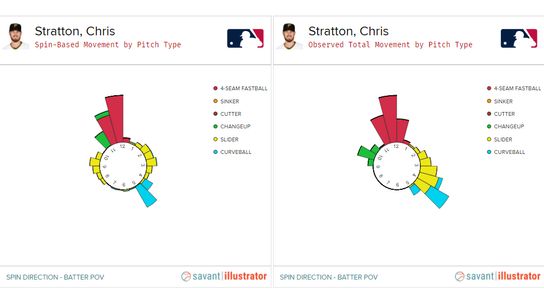
(Note: In this and the following graphics, the left chart is measured spin movement at release and the right is spin movement as it crosses home plate.)
Those graphics look chaotic without context, so lets break it down. Musgrove is one of just a handful of pitchers who has two breaking balls that spin in a similar direction. In his introductory piece on spin direction, Mike Petriello used Shane Bieber to illustrate spin direction and how similar directions can be utilized. Musgrove was one of his comps to Bieber's spin. They look and move similar for a bit, then the pitches break differently. That keeps hitters guessing.
Of course, not every pitch is going to spin the same way, but pitch mirroring, or having the exact opposite spin, can be just as effective:
That gif was made by Michael Augustine, and it shows how even though the two pitches are spinning in opposite directions, you can’t really tell. The seams are moving the same way. Tough break for those hitters who claim to be able to see that red dot.
Again, not every pitch is going to mirror with each other. Generally speaking, fastball and curveballs have a higher rate of mirroring, as do changeups and sliders, based on the magnus effect and spin axis. Sliders can mirror fastballs, too, depending on how they break.
Looking back at the earlier Musgrove graphic, his breaking pitches also mirror his fastball, which leads to tunneling like this:
Up close, slo-mo look at #Pirates Joe Musgrove's gyro-heavy four-seamer and curveball. #RaiseIt @ItsbuccnJoe59
— Augustine Visuals (@AugustineMLB) September 9, 2020
---
FF: 12:40, 70% spin efficiency
CU: 7:30, 81% spin efficiency pic.twitter.com/62RyWri9Gh
Musgrove embraced his breaking stuff more in 2020 and struck out 33% of his batters faced. All signs are pointing to him finally having a big breakout campaign in 2021, but after being the subject of trade talks for most of the last five months, it will probably be with another team.
Excluding Musgrove, which pitchers on the Pirates roster are able to mirror pitches? More specifically, mirroring their fastball and curveball, the two pitches that combo the most consistently. If you want to see the Pirates’ slider spin direction and how they pair with other pitches, here’s a link.
Looking through some of the pitchers who are no longer on the roster, Trevor Williams and Derek Holland didn’t mirror their curves well. While Williams’ hook was just a pitch he threw rarely, Holland went to his often, and going by Baseball Savant’s pitch value, it was one of the worst curveballs in the league.
Good pitch mirroring isn’t always a key to success, the same way pitches don’t need to have a high spin rate or sit in the upper-90s to be effective. Keone Kela’s hook was not in line from his fastball, and that pitch has been nasty for years, while Miguel Del Pozo's pitches were perfectly inversed and he was historically bad. But good mirroring is a tool that can lead to success.
With the exception of Musgrove, the pitcher on the staff that had the best curveball mirroring last year was actually a rookie making his MLB debut: Nick Mears:

Mears is one of the Pirates’ top reliever prospects, with his fastball sitting in the high 90s in velocity with a spin efficiency in the high 90s. He’s a sleeper in the system and will be back in the majors in 2021. As expected, his fastball does its best when its thrown up in the zone. Two years ago, he started to explore how to improve his repertoire, and ultimately decided he would be better off ditching his slider and adopting a curveball, thinking it would make both pitches better.
“I had so much ride on my fastball, I wanted to have something to counteract that,” Mears told over the phone Sunday. “Instead of going right to left, I wanted it to go top to bottom so hitters don’t give up on it as soon as it starts breaking away from them.”
Mears has spent a lot of time working on his fastball and curveball’s tunneling, which is why his curve spins the opposite way from his heater. “If it’s on the same line, it’s going to tunnel all the way there and drop out at the bottom of the zone,” he said.
To go through the rest of the Pirates’ staff, Mitch Keller has near 180-degree mirroring, too:

This is a bit off topic, but it’s interesting to see Keller’s slider spin is closer to his fastball than his curve. He’s said in the past that it behaves a bit more like a cutter. This all but officially confirms that. Again, that’s fine, especially since it is clearly his third pitch. He’s going to rely on that fastball and curve first, and if he cuts down on the walks, he’ll see an uptick in whiffs.
Some other guys who are close to mirroring their curves but don’t quite are JT Brubaker:

Cody Ponce:

And Chad Kuhl:

I wanted to take a look at the newly acquired Wil Crowe, but I am fairly certain some of his breaking pitches were misclassified last year. A couple curveballs were counted as sliders, which usually happens when a rookie first reaches the majors. The system needs a bit to learn a pitcher’s flight paths.
Looking at his spin, I think there’s some potential for mirroring here. A lot of those sliders seem to be coming out at 3 or 3:30 on this clock, while there are a whole lot at 4:30 or 5:00 that seem right in line with the sinker. I believe that is how his curveball moves:

Getting vertical break off a pitch that’s sinking doesn’t seem as useful as a four-seamer up in the zone, though. Brubaker and Kuhl are in a similar situation, but they both had effective curves.
While we’re looking at sliders that weren’t really sliders, sorry, I just can’t call Richard Rodriguez’s breaking pitch a slider. There’s too much curve to it. It’s a slurve, which is fine. It gets hitters out. Who really cares about labels at that point?
It also mirrors his high spin fastball, which he loves to throw up in the zone, pretty well:

We saw early last season what losing a couple ticks does to Rodriguez, but when he’s sitting in that 93-94 mph range, his stuff spins in harmony.
Finally, Chris Stratton. He quietly had a very effective season out of the Pirates’ bullpen last year and no pitcher in the National League threw more innings of relief than him. All of his pitches rotate a ridiculous amount, and there’s a lot of overlap with how his curveball and slider spin. However, it doesn’t mirror the fastball:
Just about every pitcher is looking for that edge in tunneling, and diving deeper into spin direction can help achieve that.
“We can feel stuff, and it will look good and feel good, but we can justify that feeling now with a Rapsodo and the data that it provides,” Mears said.
This is just another tool to justify that pitch feel.